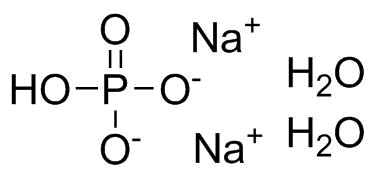
Phosphate buffer is so familiar that it is easy to forget how much chemistry is hidden in a bottle labeled disodium hydrogen phosphate dihydrate. This salt, Na2HPO4·2H2O, supplies the dibasic member of the H2PO4-/HPO42- acid-base pair. Near neutral pH, that pair can absorb added acid or base by shifting protonation state, which is why phosphate became one of the standard buffers of biochemistry, analytical chemistry, and pharmaceutical formulation.
The two waters in the crystal are not decorative. They are part of the formula mass and therefore matter whenever a solution is prepared by weighing the solid. Confusing the dihydrate with the anhydrous salt gives the wrong number of moles even if the balance reading is perfect. Hydration state also reflects the ability of phosphate ions and sodium ions to organize extensive networks of water in the solid state, an issue that becomes important during drying, storage, crystallization, and freezing.
Freezing reveals one of the most surprising features of sodium phosphate buffers. A solution can have the correct pH at room temperature and yet experience a large transient pH shift when ice forms. Water freezes first and concentrates salts in the remaining liquid. At the same time, different phosphate salts can crystallize selectively. Classic formulation studies showed that crystallization of dibasic sodium phosphate, including highly hydrated phases such as Na2HPO4·12H2O, can remove the basic member of the buffer pair and drive the unfrozen phase sharply toward lower pH.
That effect matters in frozen and lyophilized pharmaceuticals. A protein may be exposed to an acidic microenvironment while a vial is freezing, even though the solution returns toward its original pH after thawing. Such excursions can promote unfolding, aggregation, or chemical degradation. Formulators therefore think not only about the nominal room-temperature pH but also about buffer concentration, cooling rate, salt crystallization, and whether a different buffer system would remain more stable through freezing and drying.
Phosphate also has chemical consequences beyond pH. It can bind or precipitate multivalent metal ions, especially calcium, and it can interact with enzymes or surfaces. In biological work, a buffer that is excellent for one experiment can therefore interfere with another. Disodium hydrogen phosphate dihydrate is memorable because it shows that a common buffer salt is simultaneously an acid-base reagent, a crystalline hydrate, and a participant in phase behavior. The number printed after the dot in its formula can matter just as much as the pH printed on the bottle.
References:
1. PubChem. Disodium hydrogen phosphate dihydrate, CID 6451167, CAS 10028-24-7.
2. Cold Spring Harbor Protocols. Phosphate buffer. DOI: 10.1101/pdb.rec8543.
3. Gomez G., Pikal M.J., Rodriguez-Hornedo N. Effect of initial buffer composition on pH changes during far-from-equilibrium freezing of sodium phosphate buffer solutions. Pharmaceutical Research. 2001, 18, 90-97. DOI: 10.1023/A:1011082911917.
4. Pikal-Cleland K.A. et al. Protein denaturation during freezing and thawing in phosphate buffer systems. Journal of Pharmaceutical Sciences. DOI: 10.1002/jps.10184.
|







 GHS07 Warning Details
 chemBlink Chemical Story