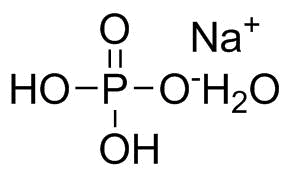
Sodium dihydrogen phosphate monohydrate is the acidic partner in one of chemistry's most useful buffer pairs. Its anion, H2PO4-, can lose a proton to become HPO42-. Mixing controlled amounts of the mono- and dibasic sodium phosphates therefore provides a convenient way to prepare solutions near physiological pH, where small additions of acid or base are absorbed by shifting the ratio between the two phosphate forms.
The word monohydrate deserves attention. NaH2PO4·H2O contains one stoichiometric water molecule per formula unit. That water changes the molar mass and must be included when solutions are prepared gravimetrically. Monohydrate, dihydrate, and anhydrous sodium dihydrogen phosphate are chemically related but are not interchangeable on a mass-for-mass basis. The distinction becomes particularly important in analytical methods, pharmaceutical manufacturing, and quality control, where a small concentration error can shift ionic strength or buffer capacity.
The phosphate pair is often introduced through the Henderson-Hasselbalch equation, but real formulations are more complicated than an equation at room temperature. Freezing concentrates solutes into the unfrozen fraction and can cause one phosphate component to crystallize before another. The resulting change in the H2PO4-/HPO42- ratio can produce a substantial pH shift. Importantly, the pH measured after thawing may look normal again, hiding the acidic or basic environment that a protein experienced while the sample was frozen.
This phenomenon became a major lesson in lyophilization science. Researchers found that proteins can lose stability during freezing because of pH excursions, increased ionic strength, ice interfaces, and cryoconcentration. Phosphate is not uniquely bad, but its tendency to undergo salt crystallization makes the effect especially visible. Formulators may adjust the mono-/dibasic ratio, reduce phosphate concentration, control cooling conditions, or select a different buffer when a sensitive biologic must survive freezing and drying.
Sodium dihydrogen phosphate monohydrate therefore connects elementary acid-base chemistry with modern pharmaceutical engineering. In a beaker it is simply an acidic phosphate salt. In a frozen vial it becomes part of a dynamic multiphase system in which ice, concentrated liquid, and crystalline salts exchange material. The memorable lesson is that pH is not always a fixed property of a formulation; during phase changes it can become a moving target, and the hydration state of the salt used to make the buffer is part of that story.
References:
1. PubChem. Sodium dihydrogen phosphate monohydrate, CID 516949, CAS 10049-21-5.
2. Cold Spring Harbor Protocols. Phosphate buffer. DOI: 10.1101/pdb.rec8543.
3. Gomez G., Pikal M.J., Rodriguez-Hornedo N. Pharmaceutical Research. 2001, 18, 90-97. DOI: 10.1023/A:1011082911917.
4. Pikal-Cleland K.A. et al. Journal of Pharmaceutical Sciences. DOI: 10.1002/jps.10184.
|






 GHS07 Warning Details
 chemBlink Chemical Story