
Online Database of Chemicals from Around the World
| Tianjin ComoraTechnology Co., Ltd. | China | |||
|---|---|---|---|---|
 | comoratj.com | |||
 | +86 15908635794 | |||
 | sales@comoratj.com | |||
 | WhatsApp:+86 15908635794 | |||
| Chemical manufacturer since 2026 | ||||
| chemBlink Standard supplier since 2026 | ||||
| Classification | Organic raw materials >> Carboxylic compounds and derivatives >> Carboxylic esters and their derivatives |
|---|---|
| Name | NOTA-bis(tBu)ester |
| Synonyms | 2-[4,7-bis[2-[(2-methylpropan-2-yl)oxy]-2-oxoethyl]-1,4,7-triazonan-1-yl]acetic acid |
| Molecular Structure | 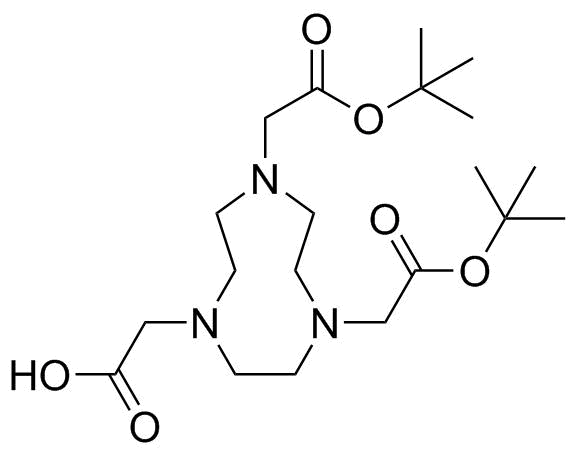 |
| Molecular Formula | C20H37N3O6 |
| Molecular Weight | 415.52 |
| CAS Registry Number | 1161415-28-6 |
| SMILES | CC(C)(C)OC(=O)CN1CCN(CCN(CC1)CC(=O)OC(C)(C)C)CC(=O)O |
| Density | 1.1±0.1 g/cm3 Calc.* |
|---|---|
| Boiling point | 519.9±50.0 °C 760 mmHg (Calc.)* |
| Flash point | 268.2±30.1 °C (Calc.)* |
| Index of refraction | 1.484 (Calc.)* |
| * | Calculated using Advanced Chemistry Development (ACD/Labs) Software. |
| Hazard Symbols |  GHS07 Warning Details |
|---|---|
| Risk Statements | H315-H319 Details |
| Safety Statements | P264-P280-P302+P352+P332+P313+P362+P364-P305+P351+P338+P337+P313 Details |
| SDS | Available |
 chemBlink Chemical Story
|
NOTA-bis(tBu)ester illustrates how protecting groups can turn a metal-binding molecule into a practical assembly component. NOTA is based on a nine-membered ring containing three nitrogen atoms and three attached acetate arms. In the bis-tert-butyl ester, two carboxyl groups are protected while one remains available as a free acid. The compound is an organic precursor, not a radioactive material by itself. Its importance lies in helping chemists connect a metal-binding unit to another molecule before the final labeling stage. The selective protection solves a problem of molecular construction. If all three acid groups were treated as interchangeable attachment points, coupling could become difficult to control. Masking two of them leaves one obvious handle for forming an amide with an amino-containing partner. After assembly, removal of the tert-butyl groups restores the remaining acid functionality. The sequence separates two tasks: building the connection to a targeting molecule and preparing the ligand environment needed for the metal-containing product. The protected reagent, its conjugate, and the radiolabeled probe are therefore different chemical entities. A concrete example appeared in a 2019 study of a pancreatic-cancer imaging probe. Researchers combined NOTA-bis(t-Bu ester) with a resin-bound peptide construct containing an aminohexanoic acid spacer. The targeting peptide, ZD2, was selected to recognize extradomain-B fibronectin, a component associated with the tumor microenvironment. Following cleavage and deprotection, the resulting NOTA-containing conjugate was labeled with gallium-68. This was a multistep transformation from a nonradioactive synthetic reagent to an experimental positron-emission tomography probe, rather than direct administration of the protected ester. The investigators evaluated the labeled conjugate in mice bearing human pancreatic-tumor xenografts. Imaging and tissue-distribution experiments supported further investigation of the targeting strategy. Those findings concern the completed probe in the particular preclinical models studied. They do not establish clinical diagnostic performance in people, and they do not show that NOTA-bis(tBu)ester itself recognizes cancer. The peptide supplies the biological recognition element, while the chelator-derived portion provides a way to incorporate the imaging metal. Keeping these roles distinct prevents a precursor from being mistaken for a diagnostic agent. A later study explored a different manufacturing concept: radiometallation followed by light-triggered release from a solid support. Its experimental work also used NOTA-bis(t-Bu ester) to attach a NOTA-derived unit to a peptide construct. This example broadens the story beyond one targeting sequence. The same type of selectively protected precursor can support research into how radiometal-containing molecules are assembled, retained, and released. It does not mean that every NOTA conjugate behaves identically; changing the attachment, peptide, or labeling conditions changes the final chemical system. The broader lesson is that molecular imaging depends on more than finding a radioactive isotope. A useful experimental probe must bring together chemical attachment, metal coordination, biological recognition, and analytical verification. NOTA-bis(tBu)ester occupies an early but purposeful position in that chain. Its two protected arms and one free acid encode a sequence of operations into a small molecule. Understanding that design explains its research value more accurately than describing the catalog reagent as an imaging medicine or assuming that the performance of a finished conjugate belongs to every NOTA derivative. Another useful distinction is between a ligand and a metal complex. A ligand supplies donor atoms, but the properties of the complex depend on which metal is present and how coordination occurs. The catalog name alone therefore cannot specify radiochemical purity, labeling efficiency, or stability of a later preparation. References: 1. Macrocyclics. NOTA-bis(t-Bu ester), B-620; CAS 1161415-28-6. https://macrocyclics.com/product/nota-bist-bu-ester/ 2. Gao S et al. Synthesis and assessment of ZD2-(68Ga-NOTA) specific to extradomain B fibronectin in tumor microenvironment for PET imaging of pancreatic cancer. Am J Nucl Med Mol Imaging. 2019;9:216-229. https://e-century.us/files/ajnmmi/9/5/ajnmmi0098262.pdf 3. Smilowicz D et al. Radiometallation and photo-triggered release of ready-to-inject radiopharmaceuticals from the solid phase. Chem Sci. 2023;14:5038-5050. DOI: 10.1039/D2SC06977F. https://pmc.ncbi.nlm.nih.gov/articles/PMC10189872/ |
| Market Analysis Reports |