
Online Database of Chemicals from Around the World
| Taizhou Crene Biotechnology Co., Ltd. | China | |||
|---|---|---|---|---|
 | www.pharm-intermediates.com | |||
 | +86 (576) 8881-3233 8820-5808 +86 13396860566 | |||
 | +86 (576) 8822-9589 | |||
 | sales@pharm-intermediates.com | |||
 | QQ Chat | |||
| Chemical manufacturer since 2011 | ||||
| chemBlink Standard supplier since 2009 | ||||
| BOC Sciences | USA | |||
|---|---|---|---|---|
| www.bocsci.com | |||
| +1 (631) 485-4226 | |||
| +1 (631) 614-7828 | |||
| info@bocsci.com | |||
| Chemical manufacturer | ||||
| chemBlink Standard supplier since 2010 | ||||
| Shanghai Forever Synthesis Co.,Ltd. | China | |||
|---|---|---|---|---|
| www.foreversyn.com | |||
| +86 (551) 6288-8437 +86 18096409024 | |||
| sales@foreversyn.com sales02@foreversyn.com | |||
| QQ Chat | |||
 | Skype Chat | |||
| Chemical distributor since 2013 | ||||
| chemBlink Standard supplier since 2018 | ||||
| Shanghai Finetech pharm Co., Ltd. | China | |||
|---|---|---|---|---|
| www.finetechpharm.cn | |||
| +86 18221039705 | |||
| ad@finetechpharm.cn | |||
| Chemical manufacturer since 2016 | ||||
| chemBlink Standard supplier since 2026 | ||||
| Cayman Chemical Company | USA | |||
|---|---|---|---|---|
| www.caymanchem.com | |||
| +1 (734) 971-3335 | |||
| +1 (734) 971-3640 | |||
| sales@caymanchem.com | |||
| Chemical manufacturer | ||||
| Dalton Pharma Services | Canada | |||
|---|---|---|---|---|
| www.dalton.com | |||
| +1 (416) 661-2102 | |||
| +1 (416) 661-2108 | |||
| chemist@dalton.com | |||
| Chemical manufacturer | ||||
| Classification | API >> Inhibitor drug |
|---|---|
| Name | 5-trans-Bimatoprost |
| Synonyms | (5E)-7-[(1R,2R,3R,5S)-3,5-Dihydroxy-2-[(1E,3S)-3-hydroxy-5-phenyl-1-penten-1-yl]cyclopentyl]-N-ethyl-5-heptenamide |
| Molecular Structure | 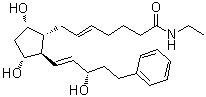 |
| Molecular Formula | C25H37NO4 |
| Molecular Weight | 415.57 |
| CAS Registry Number | 1163135-95-2 |
| EC Number | 810-193-0 |
| SMILES | CCNC(=O)CCC/C=C/C[C@H]1[C@H](C[C@H]([C@@H]1/C=C/[C@H](CCC2=CC=CC=C2)O)O)O |
| Solubility | Practically insoluble (0.04 g/L) (25 °C), Calc.* |
|---|---|
| Density | 1.145±0.06 g/cm3 (20 °C 760 Torr), Calc.* |
| Boiling point | 629.8±55.0 °C 760 mmHg (Calc.)* |
| Flash point | 334.7±31.5 °C (Calc.)* |
| Index of refraction | 1.591 (Calc.)* |
| * | Calculated using Advanced Chemistry Development (ACD/Labs) Software. |
| Hazard Symbols |   GHS07;GHS08 Danger Details GHS07;GHS08 Danger Details |
|---|---|
| Risk Statements | H302-H319-H340-H360 Details |
| Safety Statements | P203-P264-P264+P265-P270-P280-P301+P317-P305+P351+P338-P318-P330-P337+P317-P405-P501 Details |
| SDS | Available |
 chemBlink Chemical Story
|
5-trans-Bimatoprost is a stereochemical isomer within the bimatoprost family of prostaglandin-related compounds. Bimatoprost itself is a synthetic prostamide analogue structurally derived from prostaglandin F2α (PGF2α), a member of the eicosanoid family of lipid mediators. These compounds are characterized by a 20-carbon prostanoid backbone containing multiple stereocenters, hydroxyl functionalities, and an amide-linked side chain that distinguishes prostamides from classical prostaglandin esters and acids. The designation “5-trans” refers to the geometric configuration around the double bond at the 5-position of the prostanoid chain. In prostaglandin chemistry, double-bond geometry is a critical structural feature because it strongly influences the three-dimensional conformation of the molecule and, consequently, its interaction with prostaglandin and prostamide receptors. The naturally occurring prostaglandin framework typically features defined cis/trans configurations that are biosynthetically controlled through enzymatic pathways involving arachidonic acid oxidation. The development of bimatoprost and related analogues arose from research into arachidonic acid metabolism and the biological roles of prostaglandins. Prostaglandins are produced in vivo through the cyclooxygenase pathway and act as local signaling molecules involved in inflammation, vascular regulation, and ocular physiology. Synthetic analogues were designed to improve metabolic stability and receptor selectivity, as endogenous prostaglandins are rapidly degraded in biological systems. Bimatoprost differs from classical prostaglandin analogues by containing an amide-linked side chain, classifying it as a prostamide. This structural modification reduces susceptibility to enzymatic hydrolysis and contributes to prolonged biological activity. The prostanoid core retains multiple chiral centers and a long aliphatic chain, which together define its conformational flexibility and receptor-binding characteristics. In the context of stereoisomerism, the “5-trans” configuration represents an alternative geometric arrangement compared with the more commonly referenced isomeric forms of bimatoprost. Changes in double-bond geometry can alter the overall shape of the molecule, particularly the orientation of the side chain relative to the prostanoid ring system. Such differences may affect receptor affinity, pharmacological potency, and metabolic behavior, although specific biological profiles depend on the full stereochemical context of the molecule. Prostaglandin analogues such as bimatoprost are primarily associated with ophthalmic applications, where they are used to reduce intraocular pressure in conditions such as glaucoma and ocular hypertension. These compounds act by increasing aqueous humor outflow, predominantly through the uveoscleral pathway. This physiological effect is mediated through interaction with prostaglandin-related receptors in ocular tissues, leading to remodeling of extracellular matrix components in the ciliary body. The broader class of prostanoids, including prostaglandins, prostacyclins, and thromboxanes, is derived from arachidonic acid via enzymatic oxidation. Although synthetic prostamide analogues are not directly produced in biological systems, they are designed to mimic the structural and functional properties of endogenous lipid mediators while improving pharmacokinetic stability and therapeutic utility. From a chemical standpoint, 5-trans-bimatoprost retains the amphiphilic nature characteristic of prostanoid molecules. It contains multiple hydroxyl groups contributing to polarity, alongside a long hydrophobic carbon chain that facilitates membrane association. The presence of an amide linkage further influences hydrogen bonding capability and metabolic resistance compared with ester-based prostaglandin analogues. Stereochemical variation in prostaglandin analogues is a well-established area of medicinal chemistry, as small changes in configuration can significantly affect receptor binding. The prostanoid scaffold is highly sensitive to spatial arrangement, and both chiral centers and double-bond geometry contribute to biological specificity. As a result, different stereoisomers of compounds like bimatoprost are often studied to understand structure–activity relationships. Overall, 5-trans-bimatoprost is a stereoisomeric form of a synthetic prostamide analogue within the prostaglandin F2α derivative family. Its significance lies in its structural relationship to biologically active prostanoids and the role of stereochemistry in modulating the pharmacological properties of prostaglandin-based therapeutic agents. References 2005. Prediction of Genotoxicity of Chemical Compounds by Statistical Learning Methods. Chemical Research in Toxicology. DOI: 10.1021/tx049652h |
| Market Analysis Reports |