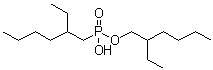
Two metals can coexist in a solution yet need to leave it by different routes. Mono(2-ethylhexyl) 2-ethylhexylphosphonate, CAS 14802-03-0, is one of the organophosphorus compounds used to create such separation opportunities. It is widely associated with the extractant name PC-88A. Its structure combines an acidic phosphorus-containing head with two branched hydrocarbon groups, giving it both a metal-interacting region and compatibility with an organic phase.
The detailed connectivity is important. One alkyl group is attached directly to phosphorus, while the other is connected through oxygen; an acidic hydroxyl group remains. This makes the compound a phosphonic acid monoester. It differs from a phosphoric acid diester such as D2EHPA and from the fully esterified, neutral extractant tributyl phosphate. These distinctions help explain why similar names do not guarantee similar extraction behavior.
Daihachi describes PC-88A as a cation-exchange extractant and identifies cobalt-nickel separation among its applications. In this kind of chemistry, the transfer of a metal ion is coupled to the acid-base behavior of the extractant. Acidity is therefore part of the separation mechanism, rather than merely a background condition. The hydrocarbon groups help keep the resulting organic-phase species in a medium different from the original aqueous feed.
Published work has compared the sodium forms of PC-88A, D2EHPA, and Cyanex 272 for cobalt and nickel recovery from sulfate solutions. Such comparisons show why extractant selection is an experimental decision: changing the phosphorus-containing group can change the balance between extraction and selectivity. The sodium form used in a study should also be distinguished from the free acid named by this product entry.
For a real mixture, extracting a large amount of metal is only one objective. Separating it from accompanying metals, recovering it into another stream, and maintaining useful phase behavior are additional requirements. Feed composition and acidity influence these outcomes, so a published separation result belongs to its tested system. It does not establish a universal recovery percentage for every waste stream or mineral leachate.
The significance of this compound lies in controlled partitioning. Its acidic head provides a chemical exchange mechanism, and its branched organic exterior helps place that mechanism at a liquid-liquid interface. Together they make a small molecular structure relevant to the larger task of separating chemically similar metals.
References:
1. Daihachi Chemical. Metal Extractants: PC-88A; identity, cation-exchange character and applications. https://www.daihachi-chem.co.jp/en/metal-extractants-pc-88a/
2. TCI. Mono-2-ethylhexyl (2-Ethylhexyl)phosphonate, CAS 14802-03-0; product M2871. https://www.tcichemicals.com/US/en/p/M2871
3. Separation and recovery of cobalt(II) and nickel(II) from sulphate solutions using sodium salts of D2EHPA, PC 88A and Cyanex 272. Hydrometallurgy. https://www.sciencedirect.com/science/article/pii/S0304386X9700073X
|






 GHS05;GHS07 DangerGHS05; Details
 chemBlink Chemical Story