
Online Database of Chemicals from Around the World
| Wuhan Waking Lion Chemicals Co., Ltd. | China | |||
|---|---|---|---|---|
 | www.wakinglionphos.com | |||
 | +86 (027) 8383-5073 | |||
 | +86 (027) 8385-1726 | |||
 | tracy@wakinglionphos.com | |||
 | WhatsApp:+8618086649478 | |||
| Chemical manufacturer since 1952 | ||||
| chemBlink Standard supplier since 2026 | ||||
| Classification | Inorganic chemical industry >> Inorganic salt >> Phosphides, metal phosphoric acid, metaphosphoric acid, hypophosphorous acid and pyrophosphate |
|---|---|
| Name | Potassium phosphate |
| Molecular Structure | 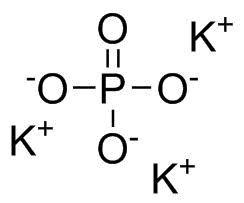 |
| Molecular Formula | H3PO4.x(K) |
| CAS Registry Number | 16068-46-5 |
| EC Number | 240-213-8 |
| SMILES | [O-]P(=O)([O-])[O-].[K+].[K+].[K+] |
| Melting point | 465 (Decomposes) °C (Expl.) |
|---|---|
| Solubility | water soluble (Expl.) |
| Hazard Classification | |||||||||||||
|---|---|---|---|---|---|---|---|---|---|---|---|---|---|
| |||||||||||||
 chemBlink Chemical Story
|
Potassium phosphate, CAS 16068-46-5, is a case where chemical information is more interesting than a single structural formula. Authoritative registry sources do not consistently assign this CAS number to one unique potassium-to-phosphate stoichiometry. The U.S. EPA lists the substance as phosphoric acid, potassium salt with an unspecified potassium ratio, while FDA records use broad names such as potassium phosphate, phosphoric acid potassium salt, and potassium orthophosphate. That matters because 'potassium phosphate' can describe several chemically distinct salts. KH2PO4 is monopotassium phosphate and is acidic in aqueous solution. K2HPO4 is dipotassium hydrogen phosphate and is more basic. K3PO4 is fully neutralized tripotassium phosphate and gives strongly alkaline solutions. These compounds have different formula weights, pH behavior, buffering roles, and applications, and they also have their own more specific registry numbers. The ambiguity is therefore not a minor naming problem. If a laboratory calculated a buffer recipe assuming K3PO4 while the actual material were a different potassium phosphate composition, both stoichiometry and pH would be wrong. In industrial products, specification sheets may define the material by potassium content, phosphate content, pH, hydration state, or assay rather than by one idealized molecule. A reliable database should preserve that uncertainty instead of forcing a precise formula where the registry identity is broad. Phosphate chemistry itself explains why several salts exist. Phosphoric acid is triprotic and can lose its three protons stepwise. Potassium hydroxide or other potassium bases can therefore neutralize one, two, or all three acidic hydrogens. The resulting H2PO4-, HPO42-, and PO43- species occupy different regions of the acid-base equilibrium. Mixtures of the first two are widely used as buffers, while the fully deprotonated salt is much more alkaline. This entry also illustrates a broader lesson in chemical informatics. A CAS Registry Number is an identifier assigned to a registered substance concept, but not every substance concept is necessarily a single pure molecule with one unambiguous formula. Mixtures, variable-composition substances, hydrates, polymers, and broadly defined salts can all challenge the assumption that identifier, name, formula, and structure always map one-to-one. CAS 16068-46-5 is therefore memorable because the correct answer is caution. For purchasing, formulation, or calculation, the user should inspect the certificate of analysis and actual potassium/phosphorus specification rather than infer a unique formula from the broad name. Sometimes the most scientifically useful database entry is the one that clearly states what is not uniquely known. References: 1. U.S. EPA Substance Registry Services. Phosphoric acid, potassium salt, CAS 16068-46-5; broad potassium stoichiometry. 2. U.S. FDA chemical inventory records for potassium phosphate / phosphoric acid, potassium salt, CAS 16068-46-5. 3. NITE J-CHECK. Phosphoric acid, potassium salt, CAS 16068-46-5. 4. Cold Spring Harbor Protocols. Phosphate buffer. DOI: 10.1101/pdb.rec8543. |
| Market Analysis Reports |