
Online Database of Chemicals from Around the World
| Shanghai PI Chemicals Ltd. | China | |||
|---|---|---|---|---|
 | www.pipharm.com | |||
 | +86 (21) 58953700 | |||
 | +86 (21) 58953701 | |||
 | sales@pipharm.com | |||
| Chemical distributor since 2007 | ||||
| chemBlink Standard supplier since 2026 | ||||
| Classification | Organic raw materials >> Carboxylic compounds and derivatives |
|---|---|
| Name | Pomalidomide-PEG4-COOH |
| Synonyms | 3-[2-[2-[2-[2-[[2-(2,6-dioxopiperidin-3-yl)-1,3-dioxoisoindol-4-yl]amino]ethoxy]ethoxy]ethoxy]ethoxy]propanoic acid |
| Molecular Structure | 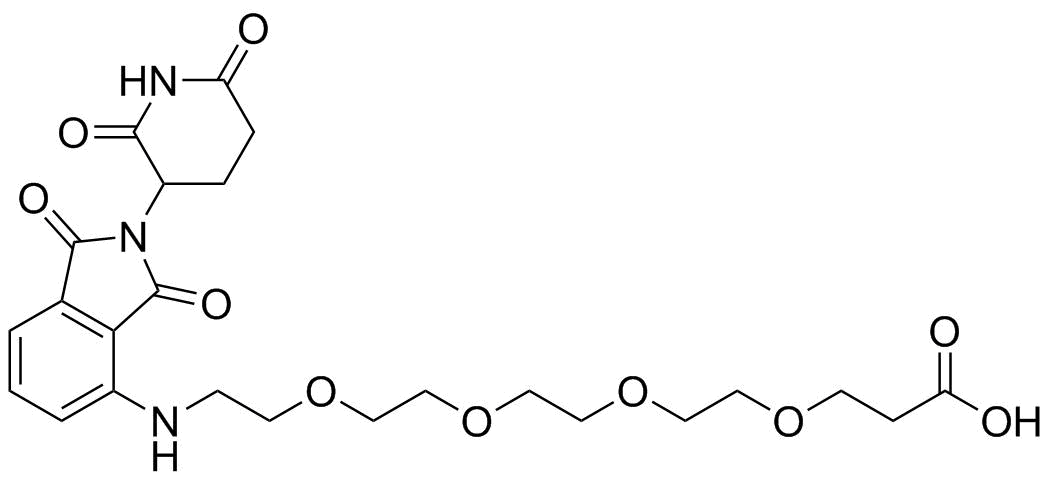 |
| Molecular Formula | C24H31N3O10 |
| Molecular Weight | 521.52 |
| CAS Registry Number | 2138440-81-8 |
| SMILES | C1CC(=O)NC(=O)C1N2C(=O)C3=C(C2=O)C(=CC=C3)NCCOCCOCCOCCOCCC(=O)O |
| Hazard Symbols |  GHS08 Warning Details |
|---|---|
| Risk Statements | H361 Details |
| Safety Statements | P501-P202-P201-P280-P308+P313-P405 Details |
| SDS | Available |
 chemBlink Chemical Story
|
Pomalidomide-PEG4-COOH combines a cereblon-directed ligand scaffold with a defined ether-containing chain and a terminal carboxylic acid. The name refers to a functionalized building block, not to the unmodified prescription drug pomalidomide. Its ring system includes a glutarimide and a phthalimide portion. At the aromatic 4 position, a nitrogen joins that scaffold to the chain. The terminal acid provides a different chemical handle at the far end. These two ends have different jobs: one is associated with ligase recruitment, while the other allows the building block to be incorporated into a larger molecule. The context is targeted protein degradation. In a typical bifunctional degrader, one ligand recognizes the intended target protein and another recruits an E3 ubiquitin ligase complex. The linker allows the two recognition elements to be held in one molecule. If the resulting assembly presents the target appropriately, the ubiquitination machinery can mark it for destruction by the proteasome. Merely joining two binding elements does not ensure that sequence of events. Binding, formation of a three-component complex and protein degradation are experimentally different outcomes. A landmark 2015 study by Winter and colleagues used phthalimide conjugation to make dBET1, which linked a BET-binding element to a cereblon-recruiting element. The work demonstrated cereblon-dependent loss of BET proteins in the systems studied. It supplies historical evidence for the broader strategy. It does not establish that the acid in this registry entry is dBET1, that it targets BET proteins on its own, or that every conjugate made from it will reproduce the published result. The manufacturer's technical information identifies this exact acid as a research building block ready for conjugation to a target-binding ligand. The meaningful application is therefore synthetic modularity. A researcher can vary the target-binding portion without redesigning every atom of the ligase-facing half. Conversely, observations on a finished degrader cannot automatically be assigned to this starting material: the other ligand, attachment points and full molecular geometry remain part of the mechanism. References: 1. Tocris. Pomalidomide 4'-PEG4-acid, product 7213 technical information. https://resources.rndsystems.com/products/documents/cofa/7213_1.pdf 2. Winter GE et al. Selective target protein degradation via phthalimide conjugation. Science. 2015;348:1376–1381. https://doi.org/10.1126/science.aab1433 |
| Market Analysis Reports |