
Online Database of Chemicals from Around the World
| HuNan Huibaiyi New Materials Co; Ltd. | China | |||
|---|---|---|---|---|
 | www.hbsjxcl.com | |||
 | +86 13319523173 | |||
 | ivy@hnhbsj.com | |||
 | QQ Chat | |||
 | WeChat: 13319523173 | |||
| Chemical manufacturer since 2014 | ||||
| chemBlink Standard supplier since 2026 | ||||
| Classification | Biochemical >> Peptide |
|---|---|
| Name | Surfactin |
| Synonyms | Surfactin C1; 3-[(3S,6R,9S,12S,15R,18S,21S,25R)-9-(carboxymethyl)-3,6,15,18-tetrakis(2-methylpropyl)-25-(10-methylundecyl)-2,5,8,11,14,17,20,23-octaoxo-12-propan-2-yl-1-oxa-4,7,10,13,16,19,22-heptazacyclopentacos-21-yl]propanoic acid |
| Molecular Structure | 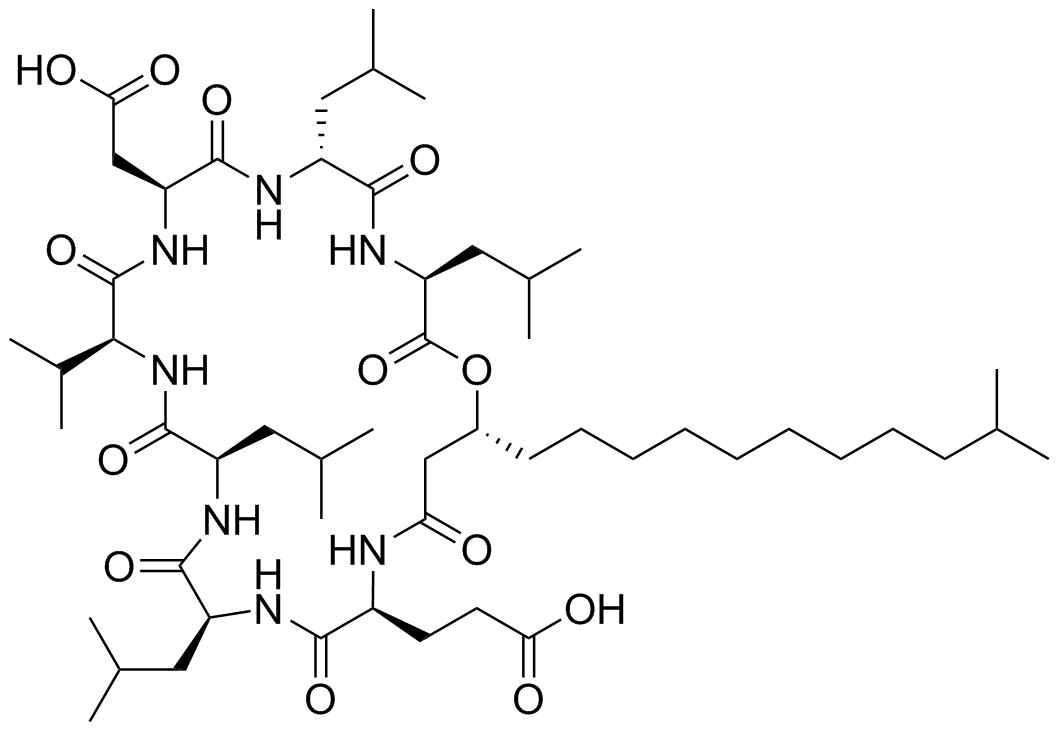 |
| Molecular Formula | C53H93N7O13 |
| Molecular Weight | 1036.34 |
| CAS Registry Number | 24730-31-2 |
| EC Number | 607-428-2 |
| SMILES | CC(C)CCCCCCCCC[C@@H]1CC(=O)N[C@H](C(=O)N[C@H](C(=O)N[C@@H](C(=O)N[C@H](C(=O)N[C@H](C(=O)N[C@@H](C(=O)N[C@H](C(=O)O1)CC(C)C)CC(C)C)CC(=O)O)C(C)C)CC(C)C)CC(C)C)CCC(=O)O |
| Density | 1.0±0.1 g/cm3 Calc.* |
|---|---|
| Boiling point | 1268.3±65.0 °C 760 mmHg (Calc.)* |
| Flash point | 720.8±34.3 °C (Calc.)* |
| Index of refraction | 1.462 (Calc.)* |
| * | Calculated using Advanced Chemistry Development (ACD/Labs) Software. |
| Hazard Symbols |  GHS07 Warning Details GHS07 Warning Details |
|---|---|
| Risk Statements | H302-H315-H319 Details |
| Safety Statements | P501-P270-P264-P280-P302+P352-P337+P313-P305+P351+P338-P362+P364-P332+P313-P301+P312+P330 Details |
| SDS | Available |
 chemBlink Chemical Story
|
Surfactin is a naturally occurring lipopeptide biosurfactant produced mainly by certain strains of *Bacillus subtilis* and related *Bacillus* species. It is one of the most extensively studied microbial surfactants due to its strong surface activity and its cyclic peptide structure linked to a fatty acid chain. Structurally, surfactin consists of a cyclic heptapeptide linked to a β-hydroxy fatty acid chain. The peptide portion contains seven amino acid residues arranged in a specific sequence that is cyclized via an internal lactone bond between the C-terminal carboxyl group and the hydroxyl group of the fatty acid. This forms a cyclic depsipeptide, meaning the ring contains both amide and ester linkages. The fatty acid moiety is typically a β-hydroxy fatty acid with a variable alkyl chain length, commonly ranging from C13 to C15 depending on the producing bacterial strain. This hydrophobic tail is a key determinant of surfactin’s amphiphilic character and is responsible for its strong interaction with lipid membranes and hydrophobic interfaces. The cyclic peptide portion contains both hydrophobic and hydrophilic amino acid residues. This arrangement creates a distinct amphipathic molecular architecture, with polar peptide regions oriented toward aqueous environments and hydrophobic residues interacting with nonpolar phases. This dual nature is essential for its surface-active properties. Surfactin is classified as a potent biosurfactant because it significantly reduces surface and interfacial tension at very low concentrations. This behavior arises from its ability to accumulate at interfaces, where the hydrophobic fatty acid chain interacts with nonpolar phases while the peptide ring interacts with water. The molecule can self-associate in solution, forming micelles or other supramolecular assemblies depending on concentration and environmental conditions. From a biosynthetic perspective, surfactin is produced non-ribosomally by large multi-enzyme complexes known as non-ribosomal peptide synthetases (NRPS). These enzymatic systems sequentially assemble the peptide chain and link it to the fatty acid moiety without the direct involvement of ribosomes. The incorporation of D- and L-amino acids in specific positions is controlled by the enzymatic modules, leading to a defined stereochemical configuration in the final product. The cyclic structure of surfactin is stabilized by both hydrogen bonding and hydrophobic interactions within the molecule. The lactone linkage between the peptide and fatty acid contributes to conformational rigidity, while the peptide backbone adopts a constrained folded structure in solution. Surfactin exhibits strong binding affinity to lipid bilayers due to its amphiphilic structure. The hydrophobic fatty acid chain can insert into lipid membranes, while the cyclic peptide portion interacts with the polar head groups. This interaction can disrupt membrane integrity at sufficient concentrations, reflecting its strong surfactant and membrane-active properties. Physicochemically, surfactin is highly surface-active and effective at very low concentrations, characteristic of biosurfactants with low critical micelle concentrations. Its amphiphilic nature allows it to reduce surface tension in aqueous systems and stabilize emulsions between oil and water phases. The molecule contains multiple functional groups capable of hydrogen bonding, including amide carbonyls and peptide NH groups, as well as hydrophobic domains contributed by aliphatic side chains and the fatty acid tail. This combination enables diverse intermolecular interactions and aggregation behavior. Overall, surfactin is a cyclic lipopeptide biosurfactant composed of a heptapeptide ring linked to a β-hydroxy fatty acid chain. Its structural features create a strongly amphiphilic molecule with pronounced surface activity, produced biosynthetically by *Bacillus* species through non-ribosomal peptide assembly systems. References 2017. Lysine Deacetylase Inhibitors in Parasites: Past, Present, and Future Perspectives. Journal of Medicinal Chemistry. DOI: 10.1021/acs.jmedchem.6b01595 2016. Surfactin derivatives from Micromonospora sp. CPCC 202787 and their anti-HIV activities. The Journal of Antibiotics. DOI: 10.1038/ja.2016.63 |
| Market Analysis Reports |