
Online Database of Chemicals from Around the World
| Shanghai Singal Industrial Co., Ltd. | China | |||
|---|---|---|---|---|
 | jusageglobal.com | |||
 | +86 (130) 0127-0101 | |||
 | jerry.zhong@jusageglobal.com | |||
 | WeChat: +86 130 0127 0101 | |||
 | WhatsApp:+86 130 0127 0101 | |||
| chemBlink Standard supplier since 2026 | ||||
| Classification | Catalysts and additives >> Polymer |
|---|---|
| Name | Polystyrene-block-polyisoprene-block-polystyrene |
| Molecular Structure | 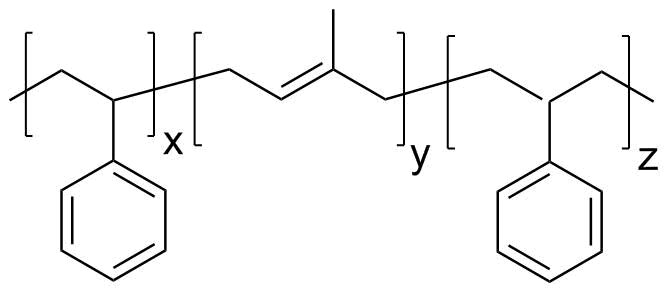 |
| Molecular Formula | (C8H8)x.(C5H8)y.(C8H8)z |
| CAS Registry Number | 25038-32-8 |
| EC Number | 607-504-5 |
| SMILES | CC(=C)C=C.C=Cc1ccccc1 |
| Density | 0.93 g/mL (25 °C) (Expl.) |
|---|---|
| Hazard Classification | |||||||||
|---|---|---|---|---|---|---|---|---|---|
| |||||||||
| SDS | Available | ||||||||
 chemBlink Chemical Story
|
Polystyrene-block-polyisoprene-block-polystyrene is commonly abbreviated SIS. The order in the name describes an architecture: a polyisoprene middle block is covalently connected to polystyrene blocks at both ends. It is not a random distribution of styrene and isoprene units along a chain. It is also not a simple mixture of two separate polymers, which could separate without the constraint imposed by joining the blocks. The architecture provides a way to put hard and soft behavior in the same material. Polystyrene and polyisoprene segments do not mix equally well at the molecular level. Under suitable conditions the blocks segregate into small domains, yet the covalent connections prevent them from simply separating into two bulk layers. In a typical elastomeric grade with a rubbery polyisoprene-rich phase, glassy polystyrene-rich domains can hold multiple chain ends. A chain whose ends occupy different domains can bridge those domains. A chain returning both ends to the same domain instead forms a loop. Thus the existence of two hard ends does not mean every chain contributes equally to the network. The associations are physical junctions rather than permanent covalent bonds between chains. When the soft segments are stretched, they can tend to recover while the hard domains restrain large-scale motion. On heating, those restraints can become less effective and the material can flow. The change in flow is not simply the melting of a small pure molecule. Segment mobility and domain organization are both relevant, and the rate at which a test is carried out can change the response observed. A 1994 study used dynamic rheological measurements to investigate the microphase separation transition in styrene-isoprene block copolymers, including triblocks. Rheology measures how stress and deformation are related. Measuring a changing response as temperature varies can reveal changes in organization that are not obvious from the polymer's elemental composition. Values from a selected series of materials should not be treated as a single transition temperature for everything listed under the same CAS. One practical application is hot-melt pressure-sensitive adhesive formulation. A coating needs to make contact with a surface under modest pressure, yet retain enough internal cohesion to avoid flowing excessively once in use. The soft block helps provide compliance, while the hard domains can help maintain cohesion. Tackifying resins and other formulation components can change the balance, so an SIS designation is not a prediction of peel strength or tack. Those are measurements of the finished adhesive on a specified surface and at a specified rate and temperature. This CAS identifies a polymer class rather than a discrete molecule with one molecular weight. Commercial grades can differ in block length, styrene fraction, and the amount of diblock present. Such differences change the number and organization of load-bearing connections. The useful design principle is that the chain sequence creates a temperature-sensitive network: the same architecture can support elastic behavior in service and flow during processing, within the conditions appropriate to the selected grade. References: 1. Kraton. Styrene-isoprene-styrene polymer safety data sheet, CAS 25038-32-8. https://sds.kraton.com/product-sds/shared-files/91209/KRATONTM-D-POLYMERS-SIS_SDS%20EU_EU%20English_14316.pdf 2. Rheology and the Microphase Separation Transition in Styrene-Isoprene Block Copolymers. Macromolecules (1994). https://doi.org/10.1021/ma00099a014 3. Kraton. Styrenic block copolymers for adhesives. https://kraton.com/markets/adhesives/ |
| Market Analysis Reports |