
Online Database of Chemicals from Around the World
| Taizhou Crene Biotechnology Co., Ltd. | China | |||
|---|---|---|---|---|
 | www.pharm-intermediates.com | |||
 | +86 (576) 8881-3233 8820-5808 +86 13396860566 | |||
 | +86 (576) 8822-9589 | |||
 | sales@pharm-intermediates.com | |||
 | QQ Chat | |||
| Chemical manufacturer since 2011 | ||||
| chemBlink Standard supplier since 2009 | ||||
| Wilshire Technologies, Inc. | USA | |||
|---|---|---|---|---|
| www.wilshiretechnologies.com | |||
| +1 (609) 683-1117 | |||
| +1 (732) 274-0049 | |||
| Wilshire-info@evonik.com | |||
| Chemical manufacturer since 1997 | ||||
| chemBlink Standard supplier since 2010 | ||||
| Molecraft LifeSciences Pvt Ltd | India | |||
|---|---|---|---|---|
| www.molecraft.com | |||
| +91 (91) 6018-8881 | |||
| +91 (40) 2359-0011 | |||
| info@molecraft.com | |||
| Chemical manufacturer | ||||
| chemBlink Standard supplier since 2012 | ||||
| Shanghai Finetech pharm Co., Ltd. | China | |||
|---|---|---|---|---|
| www.finetechpharm.cn | |||
| +86 18221039705 | |||
| ad@finetechpharm.cn | |||
| Chemical manufacturer since 2016 | ||||
| chemBlink Standard supplier since 2026 | ||||
| Dalton Pharma Services | Canada | |||
|---|---|---|---|---|
| www.dalton.com | |||
| +1 (416) 661-2102 | |||
| +1 (416) 661-2108 | |||
| chemist@dalton.com | |||
| Chemical manufacturer | ||||
| Classification | Organic raw materials >> Carboxylic compounds and derivatives >> Carboxylic esters and their derivatives |
|---|---|
| Name | Methyl-3-hydroxy-5-oxo-1-cyclopentene-1-heptanoate |
| Synonyms | methyl 7-(3-hydroxy-5-oxocyclopenten-1-yl)heptanoate |
| Molecular Structure | 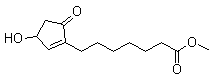 |
| Molecular Formula | C13H20O4 |
| Molecular Weight | 240.30 |
| CAS Registry Number | 40098-26-8 |
| EC Number | 690-940-3 |
| SMILES | COC(=O)CCCCCCC1=CC(CC1=O)O |
| Density | 1.1±0.1 g/cm3 Calc.* |
|---|---|
| Boiling point | 378.4±42.0 °C 760 mmHg (Calc.)* |
| Flash point | 138.9±21.4 °C (Calc.)* |
| Index of refraction | 1.504 (Calc.)* |
| * | Calculated using Advanced Chemistry Development (ACD/Labs) Software. |
| Hazard Symbols |  GHS07 Warning Details GHS07 Warning Details | ||||||||||||||||
|---|---|---|---|---|---|---|---|---|---|---|---|---|---|---|---|---|---|
| Risk Statements | H317-H319 Details | ||||||||||||||||
| Safety Statements | P280-P305+P351+P338 Details | ||||||||||||||||
| Hazard Classification | |||||||||||||||||
| |||||||||||||||||
| SDS | Available | ||||||||||||||||
 chemBlink Chemical Story
|
Methyl-3-hydroxy-5-oxo-1-cyclopentene-1-heptanoate is an organic compound that contains both a cyclopentene-derived ring system and a linear aliphatic ester side chain. Structurally, it can be described as a cyclopentenone-substituted heptanoate ester, featuring multiple functional groups including a ketone, a secondary alcohol, an alkene, and an ester linkage. Such multifunctional structures are commonly encountered as intermediates in organic synthesis and in the chemistry of oxygenated lipids and related natural product analogues. The cyclopentene portion of the molecule contains a conjugated enone system, specifically a 5-oxo-1-cyclopentene motif. Cyclopentenones are well-known electrophilic building blocks in organic chemistry due to the presence of an α,β-unsaturated carbonyl system. This arrangement activates the ring toward nucleophilic addition reactions, particularly Michael-type additions, where nucleophiles attack the β-carbon of the enone system. The reactivity of cyclopentenones has made them important intermediates in synthetic and mechanistic organic chemistry. At the 3-position of the cyclopentene ring, the compound bears a hydroxyl group. This secondary alcohol introduces additional polarity and provides a site for hydrogen bonding or further chemical modification, such as oxidation to a ketone or esterification. The stereochemical configuration of such hydroxyl-bearing centers can significantly influence reactivity and biological interactions in related systems, although the exact stereochemistry is not specified in the name. The linear side chain is a heptanoate ester, meaning a seven-carbon aliphatic chain terminating in a methyl ester group. Ester functionalities are common in both synthetic intermediates and naturally occurring lipids. They are susceptible to hydrolysis under acidic or basic conditions, yielding the corresponding carboxylic acid and methanol. In synthetic chemistry, methyl esters are often used as protecting or activated forms of carboxylic acids due to their relative stability and ease of transformation. The combination of a reactive cyclopentenone core and a flexible aliphatic ester side chain gives the molecule amphiphilic character, with a polar functionalized ring system and a hydrophobic hydrocarbon chain. This type of structural arrangement is frequently encountered in intermediates used for constructing more complex oxygenated frameworks, particularly in the synthesis of lipid-like or terpenoid-derived molecules. From a chemical reactivity standpoint, the conjugated enone system in the cyclopentene ring is the most electrophilic site in the molecule. It can participate in nucleophilic addition reactions, reductions, and cycloaddition processes. The hydroxyl group may also influence the electronic properties of the ring through inductive and hydrogen-bonding effects, potentially modulating reactivity at the enone system. The ester group at the terminus of the heptanoate chain contributes to the molecule’s overall polarity and provides a common functional handle for synthetic elaboration. Ester hydrolysis, transesterification, or reduction to alcohols are typical transformations used to further modify such structures in synthetic pathways. Compounds of this general structural type are often encountered in studies of bioactive lipid analogues and synthetic intermediates in medicinal chemistry, where cyclopentenone motifs are used as reactive pharmacophores or as scaffolds for further functionalization. However, in many cases such molecules are primarily of interest as building blocks rather than as final biologically active agents. Overall, methyl-3-hydroxy-5-oxo-1-cyclopentene-1-heptanoate is a multifunctional organic compound featuring a reactive cyclopentenone core, a hydroxyl substituent, and a methyl heptanoate side chain. Its significance lies in its combination of electrophilic enone reactivity and ester functionality, making it a versatile intermediate in synthetic organic chemistry and structural elaboration of oxygenated carbon frameworks. References 2005. Addition of Alkynylaluminum Reagents. Science of Synthesis. URL: https://science-of-synthesis.thieme.com/app/text/?id=SD-246-00105 2004. Conjugate Addition. Science of Synthesis. URL: https://science-of-synthesis.thieme.com/app/text/?id=SD-246-00105 2003. Misoprostol. Pharmaceutical Substances. URL: https://pharmaceutical-substances.thieme.com/ps/search-results?docUri=KD-16-0287 |
| Market Analysis Reports |