
Online Database of Chemicals from Around the World
| Changzhou Ditong Chemical Co., Ltd. | China | |||
|---|---|---|---|---|
 | www.edengenechem.com | |||
 | +86 (519) 8829-8848 +86 18118010980 | |||
 | info@edengenechem.com sale@edengenechem.com | |||
 | QQ Chat | |||
 | WeChat: 18118010980 | |||
| Chemical manufacturer since 2006 | ||||
| chemBlink Premium supplier since 2026 | ||||
| Classification | Chemical reagent >> Organic reagent >> Aromatic ketone |
|---|---|
| Name | 2',5'-Dihydroxyacetophenone |
| Synonyms | 2-Acetylhydroquinone; 1-(2,5-dihydroxyphenyl)ethan-1-one |
| Molecular Structure | 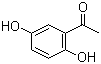 |
| Molecular Formula | C8H8O3 |
| Molecular Weight | 152.15 |
| CAS Registry Number | 490-78-8 |
| EC Number | 207-716-4 |
| SMILES | CC(=O)C1=C(C=CC(=C1)O)O |
| Density | 1.3±0.1 g/cm3 Calc.* |
|---|---|
| Melting point | 204 - 206 °C (Expl.) |
| Boiling point | 329.2±27.0 °C 760 mmHg (Calc.)* |
| Flash point | 167.1±20.2 °C (Calc.)* |
| Index of refraction | 1.595 (Calc.)* |
| * | Calculated using Advanced Chemistry Development (ACD/Labs) Software. |
| Hazard Symbols |  GHS07 Warning Details GHS07 Warning Details | ||||||||||||||||
|---|---|---|---|---|---|---|---|---|---|---|---|---|---|---|---|---|---|
| Risk Statements | H315-H319-H335 Details | ||||||||||||||||
| Safety Statements | P261-P264-P264+P265-P271-P280-P302+P352-P304+P340-P305+P351+P338-P319-P321-P332+P317-P337+P317-P362+P364-P403+P233-P405-P501 Details | ||||||||||||||||
| Hazard Classification | |||||||||||||||||
| |||||||||||||||||
| SDS | Available | ||||||||||||||||
 chemBlink Chemical Story
|
2',5'-Dihydroxyacetophenone is a hydroxyl-substituted acetophenone belonging to the class of aromatic ketones. It consists of an acetophenone framework with two hydroxyl groups attached to the benzene ring at the 2' and 5' positions relative to the acetyl substituent. The compound is characterized by the combination of a conjugated aromatic carbonyl system and two phenolic hydroxyl groups, giving it chemical properties associated with polyphenolic aromatic compounds. Acetophenone derivatives have been studied extensively in organic chemistry because the acetylbenzene structure provides a versatile platform for chemical modification. The introduction of hydroxyl groups into aromatic ketones produces compounds with altered electronic properties and increased hydrogen-bonding ability. Hydroxylated acetophenones occur naturally in some plant-derived materials and have also been prepared synthetically for use as intermediates in organic chemistry. The structure of 2',5'-dihydroxyacetophenone consists of a benzene ring connected to an acetyl group and substituted with two hydroxyl groups. The aromatic ring contains a delocalized pi-electron system that provides stability and allows interaction between the ring and the carbonyl group. The acetyl substituent is conjugated with the aromatic system, creating an aromatic ketone structure. The ketone functional group contains a carbonyl carbon that is sp2-hybridized and has trigonal planar geometry. The carbonyl oxygen possesses lone pairs of electrons and acts as a hydrogen bond acceptor. The carbonyl group is polarized, making the carbonyl carbon an electrophilic center capable of participating in nucleophilic addition reactions. The two hydroxyl groups attached directly to the aromatic ring are phenolic hydroxyl groups. Each hydroxyl oxygen contains lone pairs of electrons and can participate in hydrogen bonding. The hydroxyl hydrogens can act as hydrogen bond donors, while the oxygen atoms can function as hydrogen bond acceptors. These groups significantly increase the polarity of the molecule compared with unsubstituted acetophenone. The arrangement of hydroxyl groups at the 2' and 5' positions influences the electronic properties of the molecule. The ortho hydroxyl group adjacent to the acetyl substituent can participate in intramolecular hydrogen bonding with the carbonyl oxygen. This interaction can affect molecular conformation and influence the reactivity and physical properties of the compound. The hydroxyl groups also modify the aromatic ring through electron donation by resonance. The oxygen atoms can contribute electron density into the aromatic pi-system, making the ring more electron-rich compared with acetophenone. This electronic effect influences the behavior of the compound in aromatic substitution reactions and contributes to the characteristic chemistry of hydroxyacetophenones. The compound has been investigated as an intermediate in organic synthesis. Hydroxyacetophenones are useful starting materials for preparing more complex aromatic compounds, including flavonoid-related structures, heterocyclic compounds, and other oxygen-containing organic molecules. The combination of phenolic hydroxyl groups and a carbonyl functionality provides multiple sites for chemical transformation. The phenolic hydroxyl groups can undergo reactions such as etherification and esterification, allowing modification of the aromatic structure. The carbonyl group can participate in condensation reactions and reductions, providing additional synthetic pathways. These properties make 2',5'-dihydroxyacetophenone a useful building block in laboratory synthesis. In natural product chemistry, hydroxylated acetophenones have been studied because related structures occur in various plant-derived compounds. Their aromatic hydroxyl groups and carbonyl functionality contribute to interactions with biological molecules and have made this class of compounds of interest in chemical and biochemical research. The physical properties of 2',5'-dihydroxyacetophenone are determined by the balance between its aromatic framework and oxygen-containing functional groups. The benzene ring and acetyl methyl group provide hydrophobic character, while the carbonyl and hydroxyl groups contribute polarity and hydrogen-bonding capability. Overall, 2',5'-dihydroxyacetophenone is a hydroxylated aromatic ketone containing a conjugated acetophenone core and two phenolic hydroxyl groups. Its combination of carbonyl reactivity, hydrogen-bonding ability, and aromatic electronic properties makes it a valuable compound for organic synthesis, natural product research, and studies involving substituted aromatic ketones. References 2026. Harnessing probiotic fermentation for cabbage-based functional food: enhancing bioactive compounds and cytotoxicity properties. Journal of Food Measurement and Characterization. DOI: 10.1007/s11694-026-04110-6 2026. Evaluation of antidiabetic potential of Prunus domestica L. endocarp extract: histopathological, biochemical, in-silico molecular docking and pharmacokinetic studies. Chemical Papers. DOI: 10.1007/s11696-026-04666-z 2025. Advancing spatial-omics through Pyxis, vendor-neutral software for ion mobility mass spectrometry imaging data analysis. Analytical and Bioanalytical Chemistry. DOI: 10.1007/s00216-025-06281-5 |
| Market Analysis Reports |