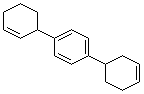
Hydrogenated terphenyl is not a single pure molecule in the ordinary sense. CAS 61788-32-7 refers to a mixture of hydrogenated terphenyl-related hydrocarbons used as a high-temperature heat-transfer fluid. That mixture identity is part of its chemistry, not an inconvenience to be hidden. Commercial materials such as Therminol 66 contain substantial amounts of partially hydrogenated terphenyls together with related aromatic species, giving a liquid whose bulk thermal properties are more important than one exact structural formula.
Heat-transfer fluids solve a basic industrial problem: move heat efficiently between a furnace, reactor, storage unit, or process line without boiling, freezing, reacting, or decomposing within the operating window. Water is excellent near ordinary temperatures but requires pressure at high temperature. Aromatic synthetic fluids extend the useful range. Hydrogenating part of the terphenyl aromatic system changes melting behavior, viscosity, and low-temperature handling while retaining enough aromatic character for high-temperature stability.
This balance explains the success of hydrogenated terphenyl mixtures. Literature describing Therminol 66 treats it as a widely used high-temperature thermal oil, and analytical work identifies characteristic cyclohexylbiphenyl components. The fluid can circulate through closed loops, carrying heat from a heater to reactors or other process equipment. Its value lies in remaining pumpable over a broad range and resisting decomposition long enough for practical service.
But heat-transfer oils age. At high temperature, thermal cracking can create lower-boiling products while condensation and polymerization can generate heavier species. Both changes matter: light products can raise vapor pressure and flash risk, while heavy products can increase viscosity and form deposits. Industrial maintenance therefore includes monitoring fluid composition, viscosity, acidity, flash behavior, and degradation rather than assuming the original fluid remains unchanged indefinitely.
Mixture composition also complicates chemical analysis after accidental contamination. A pure compound can often be tracked by one marker peak, whereas hydrogenated terphenyl fluids contain several related components. Analysts may therefore select characteristic cyclohexylbiphenyl signals or chromatographic fingerprints to identify the material in food or process samples. This analytical problem reinforces the central point: mixture substances are defined by a compositional envelope. Quality control asks whether the pattern remains within specification, not whether every molecule is identical from batch to batch.
Hydrogenated terphenyl matters because it shows why some industrial chemicals are best understood as engineered mixtures. There is no need for every molecule in a circulating thermal oil to be identical. What matters is a controlled composition that produces the desired freezing point, viscosity, vapor pressure, heat capacity, and thermal stability. Here, partial hydrogenation of an aromatic mixture is not incomplete chemistry; it is the design strategy that creates the useful operating envelope.
References:
1. Eastman Chemical Company. Therminol 66 technical and safety information; CAS 61788-32-7.
2. Moh M et al. Journal of the American Oil Chemists' Society. 2002. DOI: 10.1007/s11746-002-0492-8.
3. High temperature stability of a commercial terphenyl-based thermal oil. Thermal Science and Engineering Progress. 2021.
4. ACS Sustainable Chemistry and Engineering. Commercial heat-transfer fluid comparison. DOI: 10.1021/acssuschemeng.7b02918.
|





 GHS07 Warning Details
 chemBlink Chemical Story