
Online Database of Chemicals from Around the World
| Hangzhou Leap Chem Co., Ltd. | China | |||
|---|---|---|---|---|
 | www.leapchem.com | |||
 | +86 (571) 8771-1850 | |||
 | market19@leapchem.com | |||
 | QQ Chat | |||
| Chemical manufacturer since 2006 | ||||
| chemBlink Standard supplier since 2015 | ||||
| Amadis Chemical Co., Ltd. | China | |||
|---|---|---|---|---|
| www.amadischem.com | |||
| +86 (571) 8992-5085 | |||
 | +86 (571) 8992-5065 | |||
| sales@amadischem.com | |||
| Chemical manufacturer since 2010 | ||||
| chemBlink Standard supplier since 2015 | ||||
| INA Pharmaceuticals Pvt. Ltd. | India | |||
|---|---|---|---|---|
| inapharma.in | |||
| +91 7815933367 | |||
| rd@inapharma.in | |||
| Chemical manufacturer since 2018 | ||||
| chemBlink Standard supplier since 2026 | ||||
| Alfa Aesar. | USA | |||
|---|---|---|---|---|
| www.alfa.com | |||
| +1 (978) 521-6300 | |||
| +1 (978) 521-6350 | |||
| info@alfa.com | |||
| Chemical manufacturer | ||||
| Apollo Scientific Ltd. | UK | |||
|---|---|---|---|---|
| www.apolloscientific.co.uk | |||
| +44 (161) 406-0505 | |||
| +44 (161) 406-0506 | |||
| sales@apolloscientific.co.uk | |||
| Chemical manufacturer | ||||
| Atlantic Research Chemicals Ltd. | UK | |||
|---|---|---|---|---|
| www.atlantic-chemicals.com | |||
| +44 (8707) 746-454 | |||
| +44 (8707) 746-455 | |||
| info@atlantic-chemicals.com | |||
| Chemical manufacturer | ||||
| Ricci Chimica | Italy | |||
|---|---|---|---|---|
| www.riccichimica.com | |||
| +39 (75) 692-9241 | |||
| +39 (75) 592-6595 | |||
| info@riccichimica.com | |||
| Chemical manufacturer | ||||
| Rare Chemicals GmbH | Germany | |||
|---|---|---|---|---|
| www.rarechem.de | |||
| +49 (431) 5606-600 | |||
| +49 (431) 5606-608 | |||
| info@rarechem.de | |||
| Chemical manufacturer since 1997 | ||||
| Frontier Specialty Chemicals | USA | |||
|---|---|---|---|---|
| www.frontierspecialtychemicals.com | |||
| +1 (435) 753-1901 | |||
| +1 (435) 753-6731 | |||
| sales@frontierspecialtychemicals.com | |||
| Chemical manufacturer since 1975 | ||||
| Classification | Pharmaceutical intermediate >> Heterocyclic compound intermediate >> Pyridine compound >> Pyridine derivative |
|---|---|
| Name | 3,5-Difluoropyridine-2-carboxylic acid |
| Synonyms | 3,5-Difluoropicolinic acid |
| Molecular Structure | 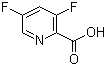 |
| Molecular Formula | C6H3F2NO2 |
| Molecular Weight | 159.09 |
| CAS Registry Number | 745784-04-7 |
| EC Number | 676-912-3 |
| SMILES | C1=C(C=NC(=C1F)C(=O)O)F |
| Density | 1.5±0.1 g/cm3 Calc.* |
|---|---|
| Melting point | 203 - 208 °C (Expl.) |
| Boiling point | 240.6±35.0 °C 760 mmHg (Calc.)* |
| Flash point | 99.3±25.9 °C (Calc.)* |
| Index of refraction | 1.515 (Calc.)* |
| * | Calculated using Advanced Chemistry Development (ACD/Labs) Software. |
| Hazard Symbols |  GHS07 Warning Details GHS07 Warning Details | ||||||||||||||||
|---|---|---|---|---|---|---|---|---|---|---|---|---|---|---|---|---|---|
| Risk Statements | H315-H319-H335 Details | ||||||||||||||||
| Safety Statements | P261-P264-P264+P265-P271-P280-P302+P352-P304+P340-P305+P351+P338-P319-P321-P332+P317-P337+P317-P362+P364-P403+P233-P405-P501 Details | ||||||||||||||||
| Hazard Classification | |||||||||||||||||
| |||||||||||||||||
| SDS | Available | ||||||||||||||||
 chemBlink Chemical Story
|
3,5-Difluoropyridine-2-carboxylic acid, CAS 745784-04-7, is a fluorinated heteroaromatic carboxylic acid used as a building block in organic and medicinal chemistry. It is also known as 3,5-difluoropicolinic acid. Its molecular formula is C6H3F2NO2 and its molecular weight is 159.09. The molecule is based on picolinic acid, a pyridine ring carrying a carboxylic acid adjacent to the ring nitrogen. In this derivative, fluorine atoms occupy the 3- and 5-positions. At first glance, the two fluorine atoms might appear simply to make this a fluorinated version of picolinic acid. Synthetically, however, the molecule is much more interesting. It contains several positions that can perform different jobs. The carboxylic acid can be converted into esters, acid chlorides, amides, and other carboxylic-acid derivatives. The fluorinated pyridine ring provides another type of reactivity. Fluorine forms one of the strongest bonds to carbon, so an aromatic C-F bond may sound like an unlikely place to perform substitution. In electron-deficient heteroaromatic rings, however, the situation can be very different. Pyridine already contains an electronegative ring nitrogen. Additional electron-withdrawing substituents can make certain ring carbons susceptible to attack by nucleophiles. Under suitable conditions, fluoride can then leave through nucleophilic aromatic substitution. Published synthetic chemistry with 3,5-difluoropyridine-2-carboxylic acid provides a particularly useful demonstration. In one documented procedure, the compound was reacted with cis-2,6-dimethylmorpholine in the presence of a tertiary amine base. The reaction did not simply modify the carboxylic acid. Instead, the cyclic amine replaced one of the fluorine atoms on the pyridine ring. The product retained the carboxylic acid and one fluorine while acquiring a new carbon-nitrogen bond at the position formerly occupied by the other fluorine. This is an important type of molecular editing. A fluorine atom can serve as a temporary placeholder. Its presence helps define the starting heteroaromatic structure, but when the appropriate nucleophile is introduced, that position can become the attachment point for a much larger molecular fragment. The second fluorine does not necessarily have to react at the same time. This makes sequential functionalization possible: one position can be modified while another substituent remains available or is intentionally preserved in the target structure. The carboxylic acid provides an independent construction site. Published medicinal-chemistry and patent routes have repeatedly coupled 3,5-difluoropyridine-2-carboxylic acid with amines to form amides. A typical peptide-coupling strategy activates the carboxylic acid with reagents such as carbodiimides or uronium coupling agents. An amine then attacks the activated carbonyl and forms a new C-N bond. In one documented example, 3,5-difluoropicolinic acid was coupled with a complex amine using HBTU and base in dimethylformamide, giving the corresponding 3,5-difluoropicolinamide derivative in 86% yield. In another preparation, the acid was converted to its acid chloride with thionyl chloride. This activated derivative could then be reacted with an amine to construct another amide. The two types of chemistry are fundamentally different. At the carboxyl group: COOH → CONR2 At a fluorinated ring carbon: C-F → C-N One reaction modifies the side group attached to the pyridine. The other directly edits the aromatic ring itself. This is why small fluorinated heterocycles are so useful in medicinal chemistry. Their value is not necessarily that they possess biological activity on their own. Instead, they provide compact frameworks on which larger molecular structures can be assembled in controlled ways. 3,5-Difluoropyridine-2-carboxylic acid can even demonstrate another surprising aspect of aromatic fluorine chemistry. In a published patent experiment, the compound was heated with lithium hydroxide and water at 100 °C. The reaction produced a mixture of monofluorohydroxypicolinic acids. In other words, one fluorine was replaced by hydroxyl. The experiment produced both positional isomers, showing that the two fluorinated sites can both participate under sufficiently forcing conditions. Those hydroxy products were subsequently methylated to give corresponding methoxy derivatives. The sequence can therefore be simplified as: C-F → C-OH → C-OCH3 Again, fluorine functions not merely as a permanent substituent but as a position that can be chemically rewritten. The carboxylic acid can also be temporarily changed when required. Published procedures convert 3,5-difluoropyridine-2-carboxylic acid into its methyl or ethyl ester. One reported esterification in ethanol and sulfuric acid gave ethyl 3,5-difluoropicolinate in 88% yield. These transformations illustrate the versatility of a molecule containing only six carbon atoms. A chemist can modify the carboxylic acid while leaving the fluorinated ring intact. A nucleophile can replace a fluorine while preserving the carboxylic acid. Or both regions can be transformed at different stages of a longer synthesis. This ability to perform different reactions at different molecular positions is especially valuable when researchers prepare families of related compounds. A common intermediate can be made first. Different amines can then be attached through the carboxyl group, different nucleophiles can be introduced onto the pyridine ring, or one fluorine can be retained to tune the properties of the final molecule. Fluorine itself is also important in medicinal chemistry because replacing hydrogen with fluorine can alter electronic properties, metabolic stability, conformation, acidity, and molecular interactions. But these effects depend strongly on the complete molecular structure. It would therefore be misleading to assign a particular pharmaceutical effect to 3,5-difluoropyridine-2-carboxylic acid itself simply because it is fluorinated. Its documented importance is more fundamental. It is a molecular construction platform. The pyridine nitrogen establishes an electron-deficient heteroaromatic framework. The carboxylic acid provides one route for extending the molecule. The fluorinated ring provides other positions that can either remain fluorinated or undergo substitution. This leads to a useful lesson about fluorine in organic synthesis. A fluorine atom is not always there to stay. Sometimes it is placed in a molecule precisely because the carbon carrying it can later become the location of something much larger. References 1. Sigma-Aldrich / Fluorochem. 3,5-Difluoropyridine-2-carboxylic acid, CAS 745784-04-7. Molecular formula C6H3F2NO2; molecular weight 159.09. 2. WO 2009/010801. Synthetic transformations of 3,5-difluoropicolinic acid, including nucleophilic substitution with cis-2,6-dimethylmorpholine. 3. WO 2011/020806. Preparation of amide derivatives from 3,5-difluoropyridine-2-carboxylic acid. 4. WO 2014/138484. Hydrolysis/substitution of 3,5-difluoropyridine-2-carboxylic acid to monofluorohydroxypicolinic acids and subsequent methylation. 5. EP 2305672 A1. Preparation of 3,5-difluoropyridine-2-carboxylic acid by acidic hydrolysis of a precursor. |
| Market Analysis Reports |