
Online Database of Chemicals from Around the World
| Suzhou Myland Pharm & Nutrition Inc. | China | |||
|---|---|---|---|---|
 | www.mylandpharm.com | |||
 | +86 (512) 6615-0687 | |||
 | +86 (512) 6615-7101 | |||
 | info@mylandpharm.com | |||
 | QQ Chat | |||
| Chemical manufacturer since 2013 | ||||
| chemBlink Standard supplier since 2014 | ||||
| Classification | Organic raw materials >> Carboxylic compounds and derivatives >> Salt of carboxylic acid ester and its derivatives |
|---|---|
| Name | Magnesium bis(2-acetamidoethanesulfonate) |
| Synonyms | Magnesium acetyltaurinate |
| Molecular Structure | 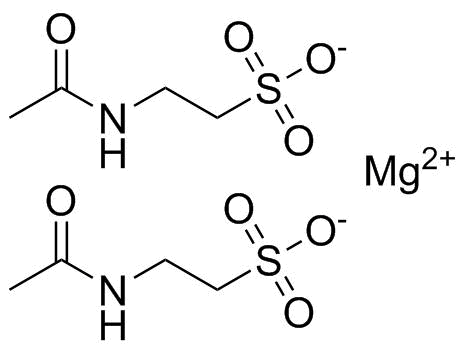 |
| Molecular Formula | C8H16MgN2O8S2 |
| Molecular Weight | 356.66 |
| CAS Registry Number | 75350-40-2 |
| EC Number | 814-183-7 |
| SMILES | CC(=O)NCCS(=O)(=O)[O-].CC(=O)NCCS(=O)(=O)[O-].[Mg+2] |
| Hazard Symbols |  GHS07 Warning Details GHS07 Warning Details |
|---|---|
| Risk Statements | H302-H315-H319-H335 Details |
| Safety Statements | P261-P264-P270-P271-P280-P301+P312-P302+P352-P304+P340-P305+P351+P338-P330-P332+P313-P337+P313-P362-P403+P233-P405-P501 Details |
| SDS | Available |
 chemBlink Chemical Story
|
Magnesium bis(2-acetamidoethanesulfonate) is an inorganic–organic coordination salt composed of a divalent magnesium cation associated with two molecules of 2-acetamidoethanesulfonate. The compound belongs to a class of metal salts formed from sulfonate-containing organic ligands, in which strong ionic interactions dominate the solid-state structure. The organic ligand, 2-acetamidoethanesulfonate, contains three key functional regions: a sulfonate group (–SO₃⁻), an acetamide moiety (–NHCOCH₃), and a short ethylene backbone linking these groups. The sulfonate group is strongly acidic in its conjugate acid form and exists fully deprotonated under physiological or neutral conditions, providing a highly charged anionic site. This makes it a strong coordinating group for metal ions such as magnesium. Magnesium, as a small divalent cation (Mg²⁺), typically exhibits a strong preference for oxygen donor ligands and often adopts octahedral coordination geometry in aqueous and solid-state complexes. In magnesium bis(2-acetamidoethanesulfonate), the magnesium ion is stabilized through electrostatic interactions and coordination with oxygen atoms from the sulfonate groups. Depending on hydration or crystalline environment, additional coordination sites may be occupied by water molecules or other oxygen donors. The acetamido group contributes additional polarity and hydrogen-bonding capability but is generally not the primary site of metal coordination due to resonance stabilization of the amide bond. Instead, it plays a structural role in organizing intermolecular hydrogen bonding networks, which can influence crystal packing, solubility, and stability. The ethylene linker between the amide and sulfonate groups provides flexibility to the ligand, allowing it to adopt conformations that facilitate optimal coordination to the magnesium ion. This flexibility can influence the overall geometry of the coordination environment and the solid-state arrangement of the salt. From a physicochemical perspective, magnesium bis(2-acetamidoethanesulfonate) is expected to be highly polar due to its ionic nature and multiple functional groups capable of hydrogen bonding. The presence of the sulfonate anions ensures strong hydrophilicity, while the magnesium cation contributes to ionic character and lattice stabilization. Compounds containing sulfonate groups are generally highly water-soluble, and this property is typically retained in magnesium salts of such ligands. The combination of ionic interactions and hydrogen-bonding networks often results in crystalline materials with defined hydration states, although specific hydration behavior depends on preparation conditions and crystallization environment. Chemically, the sulfonate group is very stable and resistant to hydrolysis under normal conditions, making such compounds robust in aqueous systems. The amide functionality is also relatively stable, though it may participate in slow hydrolysis under strongly acidic or basic conditions. Without verified literature specific to this exact compound, no claims can be made regarding biological activity or pharmaceutical use. Based on established structural chemistry, magnesium bis(2-acetamidoethanesulfonate) can be reliably described as a highly water-soluble ionic coordination salt in which magnesium is stabilized by sulfonate oxygen donors within a flexible, hydrogen-bonding organic framework. |
| Market Analysis Reports |