
Online Database of Chemicals from Around the World
| LOBA Feinchemie AG | Austria | |||
|---|---|---|---|---|
 | www.loba.co.at | |||
 | +43 (223) 277-391 | |||
 | +43 (223) 276-677 | |||
 | sales@loba.co.at | |||
| Chemical distributor | ||||
| chemBlink Standard supplier since 2012 | ||||
| Carbosynth China Ltd. | China | |||
|---|---|---|---|---|
| www.carbosynth.cn | |||
| +86 (512) 6260-5585 | |||
| +86 (512) 6260-5576 | |||
| sales@carbosynth.com | |||
 | QQ Chat | |||
| Chemical manufacturer since 2006 | ||||
| chemBlink Standard supplier since 2016 | ||||
| HuNan Huibaiyi New Materials Co; Ltd. | China | |||
|---|---|---|---|---|
| www.hbsjxcl.com | |||
| +86 13319523173 | |||
| ivy@hnhbsj.com | |||
| QQ Chat | |||
 | WeChat: 13319523173 | |||
| Chemical manufacturer since 2014 | ||||
| chemBlink Standard supplier since 2026 | ||||
| Chemos GmbH & Co. KG | Germany | |||
|---|---|---|---|---|
| www.chemos.de | |||
| +49 871-966346-0 | |||
| +49 871-966346-13 | |||
| chemos@chemos.de | |||
| Chemical distributor | ||||
| Melford Laboratories Limited | UK | |||
|---|---|---|---|---|
| www.melford.co.uk | |||
| +44 (1449) 741-178 | |||
| +44 (1449) 741-217 | |||
| pfranklin@melford.co.uk sales@melford.co.uk | |||
| Chemical manufacturer since 1985 | ||||
| Molekula Ltd | UK | |||
|---|---|---|---|---|
| www.molekula.com | |||
| +44 (1747) 831-066 | |||
| +44 (1747) 831-199 | |||
| info@molekula.com | |||
| Chemical manufacturer | ||||
| Classification | Organic raw materials >> Organic phosphine compound |
|---|---|
| Name | 1-Naphthyl phosphate monosodium salt monohydrate |
| Molecular Structure | 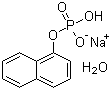 |
| Molecular Formula | C10H8NaO4P.H2O |
| Molecular Weight | 264.15 |
| CAS Registry Number | 81012-89-7 |
| EC Number | 676-830-8 |
| SMILES | C1=CC=C2C(=C1)C=CC=C2OP(=O)(O)[O-].O.[Na+] |
| Melting point | 186 - 191 °C (Expl.) |
|---|---|
| Hazard Symbols |  GHS07 Warning Details GHS07 Warning Details | ||||||||||||||||||||
|---|---|---|---|---|---|---|---|---|---|---|---|---|---|---|---|---|---|---|---|---|---|
| Risk Statements | H315-H319 Details | ||||||||||||||||||||
| Safety Statements | P264-P280-P302+P352+P332+P313+P362+P364-P305+P351+P338+P337+P313 Details | ||||||||||||||||||||
| Hazard Classification | |||||||||||||||||||||
| |||||||||||||||||||||
| SDS | Available | ||||||||||||||||||||
 chemBlink Chemical Story
|
1-Naphthyl phosphate monosodium salt monohydrate is an organic phosphate ester used primarily as a chromogenic substrate for phosphatase enzymes in biochemical and analytical assays. It consists of a naphthalene-derived aromatic group linked through an oxygen atom to a phosphate group, present as a monosodium salt with one molecule of water of crystallization. Structurally, the molecule is based on 1-naphthol, a fused bicyclic aromatic system composed of two benzene rings sharing an edge. This naphthalene core is planar and contains an extended π-electron system, which provides stability and contributes to hydrophobic character. The phosphate group is attached at the 1-position through an oxygen linkage, forming a phosphate monoester. The phosphate moiety consists of a central phosphorus atom tetrahedrally coordinated to four oxygen atoms. In the monosodium salt form, one of the acidic protons is replaced by a sodium ion, resulting in a partially ionized phosphate group. This ionic character increases aqueous solubility while maintaining the reactivity of the phosphate ester bond. The key functional bond in the molecule is the phosphate ester linkage between the naphthyl oxygen and the phosphate group. This bond is the site of enzymatic cleavage by phosphatase enzymes. Hydrolysis of this bond releases free 1-naphthol and inorganic phosphate. Upon enzymatic cleavage, 1-naphthol can undergo further chemical transformation depending on conditions. In alkaline environments, it may deprotonate to form the naphthoxide ion, which exhibits enhanced absorbance in the ultraviolet region and can be coupled to colorimetric detection systems in some assay formats. The naphthalene ring system is highly conjugated and aromatic, with delocalized electrons spread across both fused rings. This structure contributes to strong UV absorbance and hydrophobic character. The rigidity of the fused ring system ensures a well-defined geometry for enzyme recognition of the phosphate ester linkage. The phosphate group is strongly polar and capable of extensive hydrogen bonding interactions. It is also highly ionizable, and its charge state depends strongly on pH. This pH-dependent ionization plays an important role in solubility and enzymatic reactivity. The sodium ion serves as a counterion to balance negative charge on the phosphate group. It does not directly participate in the enzymatic reaction but contributes to crystallinity, solubility, and overall stability of the solid form. The monohydrate water molecule is incorporated into the crystal lattice through hydrogen bonding with phosphate oxygen atoms and contributes to solid-state stability and packing. Physicochemically, 1-naphthyl phosphate monosodium salt monohydrate is a polar, water-compatible compound despite its hydrophobic aromatic core. The balance between the naphthyl group and ionic phosphate functionality gives it amphiphilic character, allowing it to dissolve in aqueous buffer systems used in enzymatic assays. Chemically, the most important feature is the phosphate ester bond, which is selectively hydrolyzed by phosphatase enzymes under physiological conditions. This reaction forms the basis for its use as a diagnostic and analytical substrate for measuring enzyme activity. The aromatic naphthyl group remains intact during hydrolysis and primarily serves as the reporter moiety, contributing to optical detection either directly through UV absorbance or indirectly through coupling reactions in more complex assay systems. Overall, 1-naphthyl phosphate monosodium salt monohydrate is a naphthalene-based phosphate ester composed of a rigid aromatic system linked to a phosphate group stabilized by sodium ions and a water molecule of crystallization. Its enzymatic hydrolysis and resulting optical properties make it a widely used reagent in phosphatase activity assays in biochemical research. References 2016. A tissue-specific protein purification approach in Caenorhabditis elegans identifies novel interaction partners of DLG-1/Discs large. BMC Biology. DOI: 10.1186/s12915-016-0286-x |
| Market Analysis Reports |