
Online Database of Chemicals from Around the World
| Suzhou Myland Pharm & Nutrition Inc. | China | |||
|---|---|---|---|---|
 | www.mylandpharm.com | |||
 | +86 (512) 6615-0687 | |||
 | +86 (512) 6615-7101 | |||
 | info@mylandpharm.com | |||
 | QQ Chat | |||
| Chemical manufacturer since 2013 | ||||
| chemBlink Standard supplier since 2014 | ||||
| Classification | Organic raw materials >> Quinones |
|---|---|
| Name | Mitoquinone mesylate |
| Synonyms | 10-(4,5-dimethoxy-2-methyl-3,6-dioxocyclohexa-1,4-dien-1-yl)decyl-triphenylphosphanium;methanesulfonate |
| Molecular Structure | 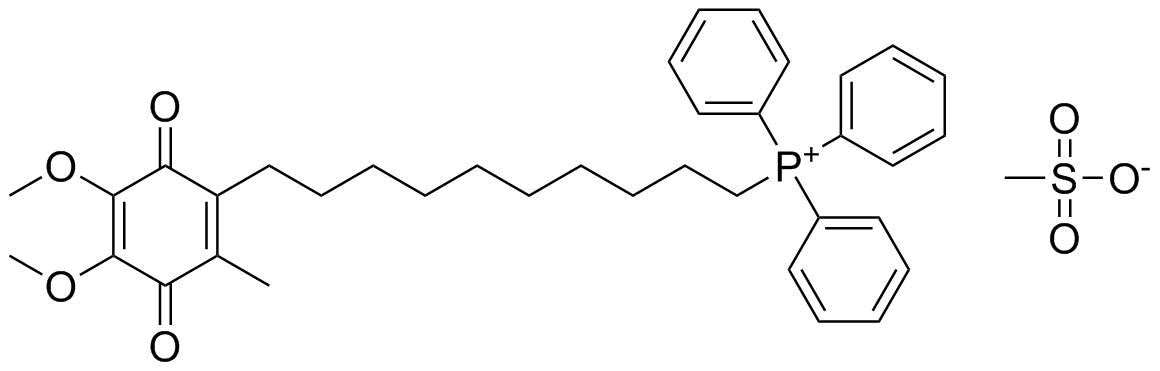 |
| Molecular Formula | C38H47O7PS |
| Molecular Weight | 678.81 |
| CAS Registry Number | 845959-50-4 |
| SMILES | CC1=C(C(=O)C(=C(C1=O)OC)OC)CCCCCCCCCC[P+](C2=CC=CC=C2)(C3=CC=CC=C3)C4=CC=CC=C4.CS(=O)(=O)[O-] |
| Hazard Symbols |  GHS07 Warning Details GHS07 Warning Details |
|---|---|
| Risk Statements | H302-H315-H319 Details |
| Safety Statements | P501-P270-P264-P280-P302+P352-P337+P313-P305+P351+P338-P362+P364-P332+P313-P301+P312+P330 Details |
| SDS | Available |
 chemBlink Chemical Story
|
Mitoquinone mesylate is a salt form of mitoquinone, a mitochondria-targeted derivative of ubiquinone (coenzyme Q). It consists of a redox-active quinone moiety linked to a lipophilic triphenylphosphonium cation, paired with a methanesulfonate (mesylate) counterion to improve stability and formulation properties. The compound was developed as part of research efforts to selectively deliver antioxidants to mitochondria, the cellular organelles responsible for oxidative phosphorylation and a major intracellular source of reactive oxygen species. The conceptual origin of mitoquinone is based on the structure and function of coenzyme Q (ubiquinone), a naturally occurring component of the mitochondrial electron transport chain. Ubiquinone participates in electron transfer between respiratory complexes and can exist in oxidized and reduced forms, enabling it to function in redox cycling. However, endogenous coenzyme Q and many conventional antioxidants distribute broadly throughout biological membranes and cytosol, which limits their selective concentration in mitochondria. To address this limitation, researchers developed a strategy for mitochondrial targeting using lipophilic cations. These molecules, particularly those containing a triphenylphosphonium group, accumulate within mitochondria driven by the large negative membrane potential across the inner mitochondrial membrane. This electrochemical gradient promotes selective uptake and retention of positively charged lipophilic compounds inside the mitochondrial matrix. Mitoquinone incorporates this targeting principle by covalently attaching a ubiquinone-like antioxidant moiety to a triphenylphosphonium cation through an alkyl linker. The quinone portion can undergo reversible redox cycling between oxidized and reduced forms, similar to coenzyme Q. This structural design allows the compound to concentrate within mitochondria where reactive oxygen species are generated as byproducts of electron transport. The mesylate form of mitoquinone refers to its association with methanesulfonate anions. Salt formation is a common pharmaceutical and chemical strategy used to improve handling, stability, and solubility characteristics of ionic compounds. In this case, the mesylate counterion balances the positive charge of the triphenylphosphonium group and provides a stable crystalline or solid form suitable for formulation and experimental use. From a structural perspective, mitoquinone mesylate contains three key components. The first is the quinone headgroup, which is responsible for redox activity. The second is a hydrocarbon linker that determines spatial separation between the quinone and the targeting moiety. The third is the triphenylphosphonium cation, which confers mitochondrial accumulation properties due to its delocalized positive charge and lipophilic aromatic substituents. Together, these components create a molecule that combines redox chemistry with subcellular targeting capability. The quinone moiety can participate in one- and two-electron redox reactions, forming semiquinone and quinol intermediates. These reversible transformations are central to its chemical behavior in biological redox environments. In mitochondrial settings, such redox-active compounds are studied for their potential ability to interact with reactive oxygen species and influence oxidative processes. The triphenylphosphonium group is a well-established mitochondrial targeting motif used in multiple research compounds. Its accumulation in mitochondria is driven by membrane potential rather than specific receptor binding, making its distribution dependent on cellular bioenergetic state. The hydrophobic phenyl rings contribute to membrane permeability, while the positively charged phosphorus center enables electrophoretic uptake into mitochondria. Mitoquinone mesylate has been widely studied in biochemical and biomedical research contexts focusing on mitochondrial oxidative stress, aging-related cellular processes, and mitochondrial function. These studies typically examine its localization properties, redox behavior, and effects on cellular oxidative markers in experimental systems. However, such investigations are context-dependent and vary across experimental models. Overall, mitoquinone mesylate is a mitochondria-targeted quinone derivative designed to accumulate within the mitochondrial matrix via a lipophilic triphenylphosphonium cation. Its significance lies in its chemical design, which links a redox-active ubiquinone analog to a mitochondrial targeting system, with the mesylate salt providing a stable and practical form for experimental and formulation use. References 2017. Development of a Mitochondriotropic Antioxidant Based on Caffeic Acid: Proof of Concept on Cellular and Mitochondrial Oxidative Stress Models. Journal of Medicinal Chemistry. DOI: 10.1021/acs.jmedchem.7b00741 2016. Therapeutic progress in amyotrophic lateral sclerosis-beginning to learning. European Journal of Medicinal Chemistry. DOI: 10.1016/j.ejmech.2016.06.017 |
| Market Analysis Reports |