
Online Database of Chemicals from Around the World
| Taizhou Crene Biotechnology Co., Ltd. | China | |||
|---|---|---|---|---|
 | www.pharm-intermediates.com | |||
 | +86 (576) 8881-3233 8820-5808 +86 13396860566 | |||
 | +86 (576) 8822-9589 | |||
 | sales@pharm-intermediates.com | |||
 | QQ Chat | |||
| Chemical manufacturer since 2011 | ||||
| chemBlink Standard supplier since 2009 | ||||
| BOC Sciences | USA | |||
|---|---|---|---|---|
| www.bocsci.com | |||
| +1 (631) 485-4226 | |||
| +1 (631) 614-7828 | |||
| info@bocsci.com | |||
| Chemical manufacturer | ||||
| chemBlink Standard supplier since 2010 | ||||
| Hangzhou Leap Chem Co., Ltd. | China | |||
|---|---|---|---|---|
| www.leapchem.com | |||
| +86 (571) 8771-1850 | |||
| market19@leapchem.com | |||
| QQ Chat | |||
| Chemical manufacturer since 2006 | ||||
| chemBlink Standard supplier since 2015 | ||||
| Shanghai Yingrui Biopharm Co., Ltd. | China | |||
|---|---|---|---|---|
| www.shyrchem.com | |||
| +86 (21) 3358-5366 3466-6753 +86 13311639313 | |||
| +86 (21) 3497-9012 | |||
| sales02@shyrchem.com | |||
| QQ Chat | |||
 | Skype Chat | |||
| Chemical manufacturer since 2009 | ||||
| chemBlink Standard supplier since 2017 | ||||
| Shanghai Finetech pharm Co., Ltd. | China | |||
|---|---|---|---|---|
| www.finetechpharm.cn | |||
| +86 18221039705 | |||
| ad@finetechpharm.cn | |||
| Chemical manufacturer since 2016 | ||||
| chemBlink Standard supplier since 2026 | ||||
| Cayman Chemical Company | USA | |||
|---|---|---|---|---|
| www.caymanchem.com | |||
| +1 (734) 971-3335 | |||
| +1 (734) 971-3640 | |||
| sales@caymanchem.com | |||
| Chemical manufacturer | ||||
| Classification | API >> Hormone and endocrine-regulating drugs >> Prostaglandins |
|---|---|
| Name | Beraprost sodium |
| Synonyms | Sodium 2,3,3a-8b-tetrahydro-2-hydroxy-1-(3-hydroxy-4-methyl-1-octen-6-ynyl)-1H-cyclopenta[b]benzofuran-5-butanoate |
| Molecular Structure | 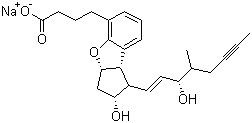 |
| Molecular Formula | C24H29NaO5 |
| Molecular Weight | 420.47 |
| CAS Registry Number | 88475-69-8 |
| EC Number | 685-277-1 |
| SMILES | CC#CCC(C)[C@@H](/C=C/[C@H]1[C@@H](C[C@H]2[C@@H]1C3=CC=CC(=C3O2)CCCC(=O)[O-])O)O.[Na+] |
| Solubility | 25 mM in DMSO (Expl.) |
|---|---|
| Hazard Symbols |    GHS06;GHS07;GHS08 Danger Details GHS06;GHS07;GHS08 Danger Details | ||||||||
|---|---|---|---|---|---|---|---|---|---|
| Risk Statements | H300-H315-H319-H335-H361 Details | ||||||||
| Safety Statements | P203-P261-P264-P264+P265-P270-P271-P280-P301+P316-P302+P352-P304+P340-P305+P351+P338-P318-P319-P321-P330-P332+P317-P337+P317-P362+P364-P403+P233-P405-P501 Details | ||||||||
| Hazard Classification | |||||||||
| |||||||||
| SDS | Available | ||||||||
 chemBlink Chemical Story
|
Beraprost sodium is the sodium salt form of beraprost, a synthetic analogue of prostacyclin (prostaglandin I₂, PGI₂). It belongs to the prostanoid class of drugs and is used primarily as a vasodilator and antiplatelet agent in the treatment of peripheral vascular diseases, particularly pulmonary arterial hypertension and conditions involving impaired microcirculation. Prostacyclin is an endogenous eicosanoid produced from arachidonic acid via the cyclooxygenase (COX) pathway in endothelial cells. It plays a critical physiological role in maintaining vascular homeostasis by promoting vasodilation and inhibiting platelet aggregation. Prostacyclin exerts its effects by activating the IP (prostacyclin) receptor, a G protein–coupled receptor that increases intracellular cyclic AMP (cAMP), leading to relaxation of vascular smooth muscle and inhibition of platelet activation. Beraprost is a chemically stable, orally active analogue of prostacyclin designed to overcome the extreme instability of endogenous PGI₂, which has a very short half-life due to rapid spontaneous hydrolysis. Structural modifications in beraprost improve its metabolic stability while retaining activity at the prostacyclin receptor. Beraprost sodium, as a salt form, enhances aqueous solubility and facilitates oral administration. After absorption, beraprost acts as the active prostacyclin receptor agonist, producing vasodilation and antiplatelet effects. These pharmacological actions improve blood flow in peripheral tissues and reduce vascular resistance. One of the key clinical applications of beraprost sodium is in pulmonary arterial hypertension (PAH), a condition characterized by elevated pulmonary vascular resistance and progressive right heart strain. By activating IP receptors in pulmonary vascular smooth muscle, beraprost promotes vasodilation of pulmonary arteries, thereby lowering pulmonary arterial pressure and improving exercise capacity. In addition to its vasodilatory effects, beraprost inhibits platelet aggregation by increasing cAMP levels in platelets. Elevated cAMP interferes with intracellular calcium signaling required for platelet activation, thereby reducing thrombus formation. This dual action on vascular tone and platelet function contributes to its therapeutic efficacy in vascular disorders. Structurally, beraprost retains the prostanoid cyclopentane core characteristic of prostacyclin derivatives, along with two aliphatic side chains and multiple stereocenters. The precise three-dimensional configuration is essential for receptor binding and biological activity, as prostacyclin receptors are highly stereospecific. Compared with endogenous prostacyclin, beraprost is more chemically stable and orally bioavailable, allowing for practical clinical use. Other prostacyclin pathway drugs, such as iloprost and epoprostenol, differ in route of administration and stability profiles, with beraprost being notable for its oral formulation. Pharmacokinetically, beraprost is absorbed in the gastrointestinal tract and undergoes hepatic metabolism. Its metabolites may retain some biological activity, contributing to its overall pharmacodynamic profile. The duration of action is longer than that of native prostacyclin but still requires repeated dosing due to metabolic clearance. From a physicochemical perspective, beraprost sodium is more hydrophilic than the free acid form, improving dissolution in aqueous environments. However, like other prostanoid compounds, it retains amphiphilic character due to its combination of polar functional groups and hydrophobic hydrocarbon chains. Overall, beraprost sodium is a stable, orally active prostacyclin analogue that acts as an IP receptor agonist to induce vasodilation and inhibit platelet aggregation. Its clinical significance lies in the treatment of pulmonary arterial hypertension and peripheral vascular disease, where it helps improve blood flow and reduce vascular resistance through modulation of the prostacyclin signaling pathway. |
| Market Analysis Reports |