
Online Database of Chemicals from Around the World
| Tianjin ComoraTechnology Co., Ltd. | China | |||
|---|---|---|---|---|
 | comoratj.com | |||
 | +86 15908635794 | |||
 | sales@comoratj.com | |||
 | WhatsApp:+86 15908635794 | |||
| Chemical manufacturer since 2026 | ||||
| chemBlink Standard supplier since 2026 | ||||
| Classification | Organic raw materials >> Carboxylic compounds and derivatives |
|---|---|
| Name | (S)-2-((tert-Butoxycarbonyl)amino)-3,3-dicyclopropylpropanoic acid |
| Synonyms | (2S)-3,3-dicyclopropyl-2-[(2-methylpropan-2-yl)oxycarbonylamino]propanoic acid |
| Molecular Structure | 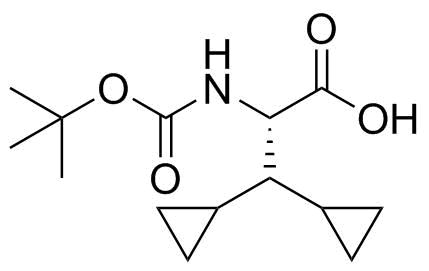 |
| Molecular Formula | C14H23NO4 |
| Molecular Weight | 269.34 |
| CAS Registry Number | 2548967-22-0 |
| SMILES | CC(C)(C)OC(=O)N[C@@H](C(C1CC1)C2CC2)C(=O)O |
| Density | 1.2±0.1 g/cm3 Calc.* |
|---|---|
| Boiling point | 420.9±28.0 °C 760 mmHg (Calc.)* |
| Flash point | 208.3±24.0 °C (Calc.)* |
| Index of refraction | 1.542 (Calc.)* |
| * | Calculated using Advanced Chemistry Development (ACD/Labs) Software. |
| Hazard Symbols |  GHS07 Warning Details |
|---|---|
| Risk Statements | H302-H315-H319 Details |
| Safety Statements | P501-P270-P264-P280-P302+P352-P337+P313-P305+P351+P338-P362+P364-P332+P313-P301+P312+P330 Details |
| SDS | Available |
 chemBlink Chemical Story
|
(S)-2-((tert-Butoxycarbonyl)amino)-3,3-dicyclopropylpropanoic acid is a stereochemically specified, protected nonproteinogenic amino acid. Its alpha carbon bears the S configuration, while the neighboring carbon carries two cyclopropyl groups. The molecule combines an unusual compact side chain with the familiar pairing of a free carboxylic acid and a Boc-protected amino group. That combination makes it a building block for assembling larger structures rather than evidence of a biological effect in its own right. The location of each function matters. The carboxylic acid is available for amide formation, whereas the nitrogen is incorporated into a carbamate protecting group. This permits a chemist to choose when the amino function is exposed during a multistep synthesis. The cyclopropyl groups are side-chain substituents; the amino-acid backbone is not incorporated into either three-membered ring. Both rings attach to the same beta carbon, giving a branched shape without adding a second stereogenic center there, because the two substituents are identical. A concrete application is documented in patent US20250197378A1 on small-molecule IL-17 modulators. Preparation 8 describes the S-configured protected acid, and Preparation 12 uses it in an amide-forming step with an amino-substituted heterocycle. Preparation 13 then exposes the amino group of the resulting intermediate. This directly supports its role as a stereochemically specified building block in the disclosed program. The activity of finished modulators must still be distinguished from the role of this starting acid. The preparation of this defined form is itself informative. In the disclosed sequence, an ester derivative is separated into enantiomeric fractions using a chiral chromatographic method, and the selected S ester is converted into the free acid while retaining Boc protection. This separates two kinds of control: selecting the molecular handedness and deciding which functional group is exposed. A change in protecting group is not a substitute for a chiral separation, and a chiral separation does not by itself expose the acid. After coupling the acid to an amine partner, the original amino group remains Boc protected. Removal of that protection creates another site for acylation and allows construction of a molecule containing two differently placed amide connections. The amino acid therefore helps organize a sequence rather than simply adding carbon content. Its side chain, stereocenter, acid-derived bond, and nitrogen-derived bond contribute different information to the final structure. This role is particularly clear when comparing closely related protected amino acids in a medicinal-chemistry program. Keeping the construction strategy similar while changing the side chain can make the resulting compounds suitable for a meaningful experimental comparison. However, the outcome cannot be read directly from the number of small rings. Solubility, target activity, and other properties belong to the whole molecule and must be measured. The verified contribution of the S-configured reagent is a reproducibly specified fragment that can be carried through that comparison with its handedness and connection points explicitly defined. The comparison with the entry lacking an S or R designation is particularly instructive. CAS 2272861-72-8 conveys no alpha configuration in its listed name, whereas CAS 2548967-22-0 specifies S. An equal formula or molecular mass cannot establish that two supplied materials have the same stereochemical composition. Nor does ordinary chemical purity automatically measure enantiomeric purity. For this reagent, the most important practical information is therefore the complete structural identity, the specified configuration, and the analytical evidence supporting the material supplied. These details determine whether it is an appropriate match for a particular synthetic plan. References: 1. ChemScene. Boc-3,3-DicPr-Ala-OH, CAS 2548967-22-0; structural and stereochemical specification. https://www.chemscene.com/product/2548967-22-0.html 2. US20250197378A1. Small molecule modulators of IL-17; Preparations 6-8 and 12-13. https://patents.google.com/patent/US20250197378A1/en 3. US11377425B2. Small molecule modulators of IL-17; Preparations 27 and 51-53. https://patents.justia.com/patent/11377425 |
| Market Analysis Reports |