
Online Database of Chemicals from Around the World
| Tianjin ComoraTechnology Co., Ltd. | China | |||
|---|---|---|---|---|
 | comoratj.com | |||
 | +86 15908635794 | |||
 | sales@comoratj.com | |||
 | WhatsApp:+86 15908635794 | |||
| Chemical manufacturer since 2026 | ||||
| chemBlink Standard supplier since 2026 | ||||
| Classification | Organic raw materials >> Carboxylic compounds and derivatives |
|---|---|
| Name | 2-((tert-Butoxycarbonyl)amino)-3,3-dicyclopropylpropanoic acid |
| Synonyms | 3,3-dicyclopropyl-2-[(2-methylpropan-2-yl)oxycarbonylamino]propanoic acid |
| Molecular Structure | 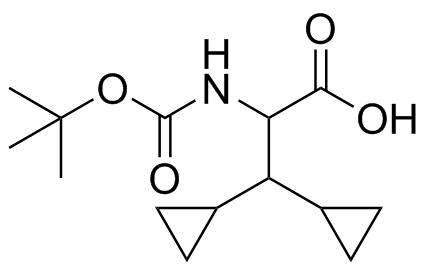 |
| Molecular Formula | C14H23NO4 |
| Molecular Weight | 269.34 |
| CAS Registry Number | 2272861-72-8 |
| SMILES | CC(C)(C)OC(=O)NC(C(C1CC1)C2CC2)C(=O)O |
| Density | 1.2±0.1 g/cm3 Calc.* |
|---|---|
| Boiling point | 420.9±28.0 °C 760 mmHg (Calc.)* |
| Flash point | 208.3±24.0 °C (Calc.)* |
| Index of refraction | 1.542 (Calc.)* |
| * | Calculated using Advanced Chemistry Development (ACD/Labs) Software. |
| Hazard Symbols |  GHS07 Warning Details |
|---|---|
| Risk Statements | H302-H315-H319 Details |
| Safety Statements | P501-P270-P264-P280-P302+P352-P337+P313-P305+P351+P338-P362+P364-P332+P313-P301+P312+P330 Details |
| SDS | Available |
 chemBlink Chemical Story
|
2-((tert-Butoxycarbonyl)amino)-3,3-dicyclopropylpropanoic acid is a protected amino-acid building block with two cyclopropyl groups on its beta carbon. It is not a cyclopropane amino acid in which the amino and carboxyl groups are attached to the three-membered ring itself. Instead, the amino-acid chain carries a branched side group containing two separate small rings. The Boc-protected nitrogen and free carboxylic acid provide the familiar differentiated functions used in peptide and amide assembly. One important piece of information is absent from the name associated with CAS 2272861-72-8: the configuration at the alpha carbon is not specified. That carbon is attached to four different groups and is stereogenic. The beta carbon, despite its branched appearance, bears two identical cyclopropyl substituents and is not a separate stereogenic center on that basis. A structure without an alpha stereochemical label must not be silently relabeled as the S enantiomer. Equally, the absence of a label alone does not establish that a particular supplied sample is an exact racemic mixture. The compound can be understood as a means of introducing an unusual side-chain shape while keeping the amino and acid functions under separate control. Boc protection masks the amino group as a carbamate, leaving the acid available for coupling. Those are structure-based synthetic possibilities; they do not prove a specific receptor activity, metabolic advantage, or clinical application for the reagent. The corresponding protected amino-acid structure appears explicitly in patent US20250197378A1. Preparation 6 describes the acid without assigning an alpha configuration. The next preparation converts it to a 4-methoxybenzyl ester and reports separation of the ester enantiomers by preparative chiral supercritical-fluid chromatography. The S-configured ester is then converted to the S acid. This provides a specific research context for discussing the structure, without assuming that every commercial sample with an unspecified name has the composition of that patent batch. The sequence illustrates the difference between making a molecular skeleton and selecting one handed form of it. An achiral structure drawing can show the required bonds, ring positions, and protecting group while omitting the arrangement at a stereogenic carbon. A later resolution step can separate the handed forms without changing those basic connections. Conversely, cleavage of the ester protecting group changes the acid functionality while the intended stereochemical identity is retained in the reported product. Such operations have different analytical questions. Chromatography intended to separate enantiomers must provide a chiral environment; an ordinary mass measurement gives the same molecular mass for both enantiomers. The two cyclopropyl rings make the side chain unusual, but they do not make the stereochemical question disappear. The documented route therefore turns a potentially confusing catalog distinction into a useful lesson in synthetic planning: establish the skeleton, control or resolve its stereochemistry, and then carry the selected material forward into the larger structure being investigated. Each stage has its own identity and should be described accordingly. This distinction becomes particularly useful when comparing it with CAS 2548967-22-0, for which an S configuration is explicitly specified. The two entries can have the same elemental formula and molecular mass while differing in the stereochemical information they convey. Conventional mass spectrometry cannot resolve that informational difference by molecular weight alone. Matching a building block to a published route therefore requires attention to its complete structural specification, including any available chiral analysis, rather than treating similar catalog names as interchangeable. References: 1. AstaTech. CAS 2272861-72-8, F83066. https://astatechinc.com/CPSResult.php?CRNO=278119 2. US20250197378A1. Small molecule modulators of IL-17; Preparations 6-8 and 12-13. https://patents.google.com/patent/US20250197378A1/en 3. US11377425B2. Small molecule modulators of IL-17; Preparations 27 and 51-53. https://patents.justia.com/patent/11377425 |
| Market Analysis Reports |