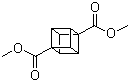
An unusual molecular shape becomes much more useful when researchers can obtain enough of it to explore. Dimethyl 1,4-cubanedicarboxylate, CAS 29412-62-2, occupies that position in cubane chemistry. Its eight-carbon cage resembles the corners of a cube, with two methyl ester groups extending from opposite vertices. The structure combines a rigid three-dimensional hydrocarbon core with functional groups that can be transformed into other derivatives.
Cubane is striking because its carbon-carbon bonds form a compact cage with angles far removed from those of an ordinary open-chain saturated hydrocarbon. The strain helps explain the molecule's scientific interest, but it does not mean that every derivative spontaneously falls apart. Strain, reaction conditions, and the possible pathways for bond rearrangement are different parts of the chemical problem. A useful building block must be sufficiently manageable to isolate and sufficiently adaptable to support further chemistry.
The ester groups provide one route to that adaptability. They distinguish this material from the corresponding free dicarboxylic acid and from a monoester. Hydrolysis changes the end groups while retaining the cubane skeleton. Other downstream chemistry can then address those groups according to the intended target. These are related structures, but their acidity and reaction roles differ, making the exact product identity important.
A practical milestone was the 2013 report of pilot-scale production of high-purity dimethyl 1,4-cubanedicarboxylate. Process development addressed access to the actual building block rather than only the conceptual attractiveness of cubane. Reproducible supply makes it possible to compare derivatives, investigate properties, and plan routes without treating every experiment as a new preparation of the cage from the beginning.
Photochemistry offers another part of the story. In 2023, Prentice and colleagues reported benzophenone as a photosensitizer for a key cycloaddition step in a route to the diester. Their work examined how light-driven construction could be improved using an accessible sensitizer. The sensitizer assists a step in the synthesis; it is not a component that defines the identity of the isolated cubane ester.
These studies illustrate two distinct ways of making a building block more useful. Process chemistry improves the practicality of obtaining it. Method development improves a particular transformation along the route. Neither achievement by itself establishes a biological benefit or a finished materials application. Instead, both expand the opportunity to investigate what can be made from the cage.
The cage and its end groups also contribute different kinds of information. The cage restricts the relative direction of the attachments, whereas the ester groups determine much of the chemistry available at those attachments. A transformation that changes an ester need not imply that the cage has changed; a transformation of the cage requires separate structural evidence. Following both elements through a sequence is important when discussing downstream products.
This separation is useful in research planning. A chemist interested in a new endpoint can start with a common cage-containing precursor, then compare routes that change the terminal groups. A process chemist instead may ask how reliably the same precursor can be isolated at a larger scale. The questions are connected through the material, but the criteria for success differ: structural diversity in one case, reproducible preparation and characterization in the other.
Dimethyl 1,4-cubanedicarboxylate is therefore a gateway molecule. Its precise geometry is the source of many design possibilities, while its ester groups provide ways to connect that geometry to subsequent chemistry. The story is not only that carbon can form a cube, but that synthetic and process research can turn that remarkable shape into a workable experimental starting point.
References:
1. TCI. Dimethyl Cubane-1,4-dicarboxylate, CAS 29412-62-2; product D5542. https://www.tcichemicals.com/US/en/p/D5542
2. Pilot-Scale Production of Dimethyl 1,4-Cubanedicarboxylate. Org Process Res Dev. 2013;17:1503-1509. https://doi.org/10.1021/op400181g
3. Prentice C et al. Benzophenone as a cheap and effective photosensitizer for the photocatalytic synthesis of dimethyl cubane-1,4-dicarboxylate. Org Biomol Chem. 2023. https://doi.org/10.1039/D3OB00231D
|






 GHS07 Warning Details
 chemBlink Chemical Story