
Online Database of Chemicals from Around the World
| Wuhan Kemi-works Chemical Co., Ltd. | China | |||
|---|---|---|---|---|
 | www.kemiworks.net | |||
 | +86 (27) 8573-6489 | |||
 | +86 (27) 8573-6485 | |||
 | info@kemiworks.net sales@kemiworks.com | |||
| Chemical manufacturer | ||||
| chemBlink Premium supplier since 2011 | ||||
| Classification | Organic raw materials >> Carboxylic compounds and derivatives >> Carboxylic esters and their derivatives |
|---|---|
| Name | 1,4-Bis(benzoyloxymethyl)cyclohexane |
| Synonyms | Benzoflex 352; [4-(benzoyloxymethyl)cyclohexyl]methyl benzoate |
| Molecular Structure | 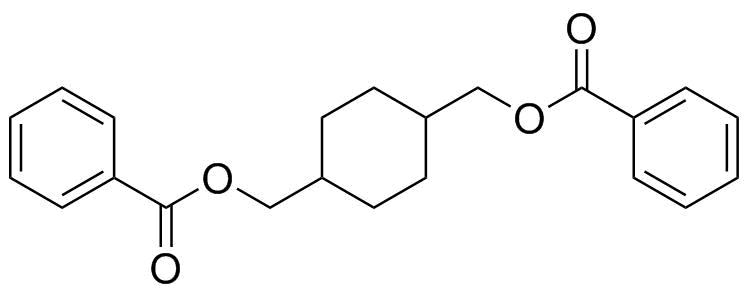 |
| Molecular Formula | C22H24O4 |
| Molecular Weight | 352.42 |
| CAS Registry Number | 35541-81-2 |
| EC Number | 609-138-1 |
| SMILES | C1CC(CCC1COC(=O)C2=CC=CC=C2)COC(=O)C3=CC=CC=C3 |
| Density | 1.1±0.1 g/cm3 Calc.* |
|---|---|
| Boiling point | 472.9±18.0 °C 760 mmHg (Calc.)* |
| Flash point | 233.7±19.6 °C (Calc.)* |
| Index of refraction | 1.55 (Calc.)* |
| * | Calculated using Advanced Chemistry Development (ACD/Labs) Software. |
| Hazard Symbols |   GHS07;GHS09 Warning Details GHS07;GHS09 Warning Details | ||||||||||||
|---|---|---|---|---|---|---|---|---|---|---|---|---|---|
| Risk Statements | H413 Details | ||||||||||||
| Safety Statements | P280-P305+P351+P338 Details | ||||||||||||
| Hazard Classification | |||||||||||||
| |||||||||||||
| SDS | Available | ||||||||||||
 chemBlink Chemical Story
|
1,4-Bis(benzoyloxymethyl)cyclohexane is an aromatic diester derivative of cyclohexane in which two hydroxymethyl substituents at the 1 and 4 positions of a cyclohexane ring are esterified with benzoic acid. The molecule therefore contains a saturated cycloaliphatic core (cyclohexane) bearing two benzylic ester side chains, each terminating in a benzoate group. This structural arrangement combines a rigid alicyclic backbone with two aromatic ester functionalities. The parent structural motif is cyclohexane-1,4-dimethanol, a diol in which hydroxymethyl groups are attached in a para-like relationship on the cyclohexane ring. In 1,4-bis(benzoyloxymethyl)cyclohexane, both hydroxyl groups are converted into benzoate esters through esterification with benzoic acid or activated benzoate derivatives. This transformation replaces the hydrogen-bonding hydroxyl groups with ester linkages, significantly altering polarity and intermolecular interactions. The cyclohexane ring can adopt chair conformations, which are energetically favorable due to minimized torsional strain. Substitution at the 1 and 4 positions allows for axial or equatorial orientations depending on stereochemistry and conformational equilibrium. This conformational flexibility influences how the molecule packs in the solid state and interacts with surrounding materials in mixtures or polymer systems. Each benzoyloxymethyl substituent consists of a methylene linker (–CH2–O–CO–Ph) connecting the cyclohexane core to an aromatic benzoate group. The ester carbonyl is the most electronically polarized portion of the molecule and is capable of undergoing hydrolysis under strongly acidic or basic conditions. Hydrolysis would regenerate benzoic acid and cyclohexane-1,4-dimethanol. The aromatic rings contribute significant hydrophobic character and increase molecular polarizability, while the ester oxygen atoms introduce moderate polarity and hydrogen-bond acceptor capability. However, because all hydroxyl groups are esterified, the compound lacks strong hydrogen-bond donor functionality, resulting in reduced hydrophilicity compared with the parent diol. From a materials chemistry perspective, compounds of this type are often associated with plasticizer-like or modifier behavior due to their combination of flexible aliphatic cores and bulky aromatic ester groups. The cyclohexane backbone provides conformational adaptability, while the benzoate groups increase compatibility with hydrophobic polymer environments and reduce volatility. The absence of free hydroxyl groups reduces intermolecular hydrogen bonding between molecules of 1,4-bis(benzoyloxymethyl)cyclohexane, which generally contributes to lower melting point and improved liquid-phase behavior. This property is useful in applications where low volatility and good miscibility with organic matrices are desired. The molecule is expected to be largely hydrophobic, with very limited water solubility due to the dominance of aromatic and aliphatic hydrocarbon content. Its ester functionality provides some polarity, but not enough to overcome the overall nonpolar character of the structure. As a result, it is more compatible with organic solvents, resins, and polymeric materials than with aqueous systems. Chemically, the most reactive sites are the ester linkages. These can be cleaved under hydrolytic conditions, while the aromatic rings are generally stable under normal chemical environments. The cyclohexane ring is also chemically inert under typical conditions, contributing to the compound’s overall stability. Overall, 1,4-bis(benzoyloxymethyl)cyclohexane is a bifunctional aromatic diester composed of a cyclohexane core linked through oxy-methylene bridges to benzoate groups. Its significance lies in its structural combination of rigidity and flexibility, its hydrophobic aromatic character, and its utility as a stable ester-based organic material in formulations and polymer-related applications. References 2025. Morphological and Crystallization Insights into Poly(isosorbide-co-1,4-cyclohexanedimethylene terephthalate): A Study of Unique Spherulitic Structures. Fibers and Polymers. DOI: 10.1007/s12221-025-01194-7 |
| Market Analysis Reports |