
Online Database of Chemicals from Around the World
| Hubei Yihua New Materials Technology Co., Ltd. | China | |||
|---|---|---|---|---|
 | yianchem.com | |||
 | +44 07892 880081 | |||
 | contact@yianchem.com | |||
 | WhatsApp:+44 07892 880081 | |||
| Chemical distributor since 2025 | ||||
| chemBlink Standard supplier since 2026 | ||||
| Classification | Organic raw materials >> Carboxylic compounds and derivatives >> Carboxylic esters and their derivatives |
|---|---|
| Name | Cyenopyrafen |
| Synonyms | [(E)-2-(4-tert-butylphenyl)-2-cyano-1-(2,4,5-trimethylpyrazol-3-yl)ethenyl] 2,2-dimethylpropanoate |
| Molecular Structure | 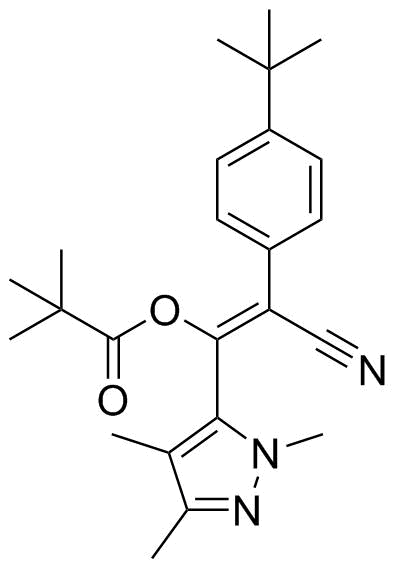 |
| Molecular Formula | C24H31N3O2 |
| Molecular Weight | 393.52 |
| CAS Registry Number | 560121-52-0 |
| EC Number | 807-436-8 |
| SMILES | CC1=C(N(N=C1C)C)/C(=C(C#N)/C2=CC=C(C=C2)C(C)(C)C)/OC(=O)C(C)(C)C |
| Density | 1.0±0.1 g/cm3 Calc.* |
|---|---|
| Boiling point | 489.1±45.0 °C 760 mmHg (Calc.)* |
| Flash point | 249.6±28.7 °C (Calc.)* |
| Index of refraction | 1.536 (Calc.)* |
| * | Calculated using Advanced Chemistry Development (ACD/Labs) Software. |
| Hazard Symbols |   GHS07;GHS09 Warning Details GHS07;GHS09 Warning Details | ||||||||||||||||
|---|---|---|---|---|---|---|---|---|---|---|---|---|---|---|---|---|---|
| Risk Statements | H317-H400-H410 Details | ||||||||||||||||
| Safety Statements | P261-P272-P273-P280-P302+P352-P321-P333+P317-P362+P364-P391-P501 Details | ||||||||||||||||
| Hazard Classification | |||||||||||||||||
| |||||||||||||||||
| SDS | Available | ||||||||||||||||
 chemBlink Chemical Story
|
Cyenopyrafen is a synthetic acaricidal compound belonging to the class of pyrazole-derived agricultural pesticides. It is used primarily for the control of phytophagous mites, including species that affect fruit trees, vegetables, and ornamental crops. The compound is part of a group of modern mite control agents developed to address resistance issues associated with earlier acaricides and to provide effective pest management tools in integrated agricultural systems. The development of cyenopyrafen is associated with the expansion of pyrazole-based agrochemicals in the late twentieth and early twenty-first centuries. Pyrazole derivatives became an important scaffold in pesticide research due to their chemical stability and the ability to introduce diverse substituents that modulate biological activity. Research programs in industrial agrochemical chemistry explored a wide range of heteroaromatic compounds to identify molecules with selective toxicity toward mite pests while maintaining safety for crops and non-target organisms. Cyenopyrafen was developed as part of efforts to discover novel acaricides with improved performance against resistant populations of spider mites. Spider mites are significant agricultural pests that feed on plant tissues, leading to reduced photosynthetic capacity, crop damage, and yield loss. The emergence of resistance to multiple classes of acaricides created a need for compounds with new modes of action and distinct chemical structures. Chemically, cyenopyrafen is characterized by a substituted pyrazole core linked to functional groups that enhance its biological activity and lipophilicity. The molecular design reflects typical features of modern agrochemical optimization, in which heterocyclic scaffolds are modified to achieve desirable properties such as target specificity, environmental stability, and plant surface retention. The presence of multiple functional substituents contributes to its ability to interact with biological systems in mites. The primary application of cyenopyrafen is in agriculture as a foliar-applied acaricide. It is used to control mite infestations in crops such as fruits and vegetables, where spider mites are a common pest. The compound is typically applied as part of pest management programs that may include rotation with other acaricides to reduce the risk of resistance development. Its use is integrated into agricultural practices that aim to maintain crop yield and quality while minimizing excessive pesticide application. Cyenopyrafen is classified as a mitochondrial electron transport inhibitor (METI)-type acaricide in many pesticide classification systems. Compounds in this group are known to interfere with energy production in mites by disrupting electron transport processes in mitochondria. This leads to inhibition of cellular respiration and ultimately results in pest mortality. The specificity of such compounds for mite physiology over other organisms contributes to their value in crop protection. The development of cyenopyrafen reflects broader trends in agrochemical research, particularly the shift toward targeted pest control agents with novel mechanisms of action. As resistance to traditional organophosphate, carbamate, and pyrethroid pesticides became widespread, research efforts increasingly focused on heterocyclic compounds such as pyrazoles, pyridines, and other nitrogen-containing systems. These scaffolds allow fine tuning of physicochemical properties and biological activity. From a formulation perspective, cyenopyrafen is typically incorporated into agricultural products designed for spray application. Its physicochemical properties, including hydrophobicity and stability under field conditions, influence its behavior on plant surfaces and its persistence in the environment. These properties are important considerations in agrochemical development, as they affect both efficacy and environmental fate. In terms of environmental and agricultural significance, cyenopyrafen is used within regulated pesticide management frameworks that govern application rates, safety intervals, and crop-specific approvals. Like other acaricides, its use is subject to guidelines intended to ensure effective pest control while minimizing impact on beneficial organisms and the surrounding ecosystem. Overall, cyenopyrafen is a modern pyrazole-based acaricide developed for the control of mite pests in agriculture. Its significance lies in its role as a targeted pest management agent within integrated agricultural systems and in its contribution to the diversification of acaricidal chemistry aimed at addressing resistance challenges in crop protection. References 2026. The sublethal effects of cyenopyrafen on life table and population traits of predatory mite, Neoseiulus longispinosus (Mesostigmata: Phytoseiidae) in F1 generation. Experimental and Applied Acarology. DOI: 10.1007/s10493-025-01105-8 2025. Presence of insecticidal veterinary medicines in dandelions (Taraxacum officinalis) in public parks in the Netherlands. Environmental Sciences Europe. DOI: 10.1186/s12302-025-01293-5 2025. Linear correlation between physical location and genetic distance of genes and recombination rates between acaricide resistance genes in the holocentric chromosome of Tetranychus urticae (Trombidiformes: Tetranychidae). Applied Entomology and Zoology. DOI: 10.1007/s13355-025-00935-7 |
| Market Analysis Reports |